

Coin Newsweek – February 27, 2026 – Global money supply has surged to an unprecedented $144 trillion, creating a liquidity environment that historically fuels hard assets. Yet while gold has marched steadily higher, Bitcoin—often hailed as “digital gold”—has delivered choppy, lackluster performance. The divergence reveals a fundamental truth about Bitcoin’s dual identity and the current state of market speculation.
According to data highlighted by The Kobeissi Letter, global broad money supply reached a record $144 trillion in December 2025, marking a $13.6 trillion year-over-year increase of 10.4%. This represents the third consecutive month of accelerating growth. Since the pandemic began, money supply has surged by $44 trillion—a staggering 44% increase. “Global money creation has never moved this fast outside of a crisis,” the analysis noted.
The classic economic script would predict: more liquidity → higher hard asset prices. Gold has followed this script perfectly, maintaining its upward trajectory despite sharp but brief drawdowns. Jurrien Timmer, Director of Global Macro at Fidelity, observed that gold has behaved exactly as expected in a bull market, with pullbacks quickly attracting renewed buying interest.
Bitcoin, however, has not followed suit. Timmer explained that the reason for this disconnect is surprisingly simple: gold is only one thing—pure “hard money.” Bitcoin, by contrast, occupies a dual identity. On one hand, it represents a potential hard currency with its fixed 21 million supply cap. On the other, it functions as a speculative risk asset, closely correlated with tech stocks and growth expectations.
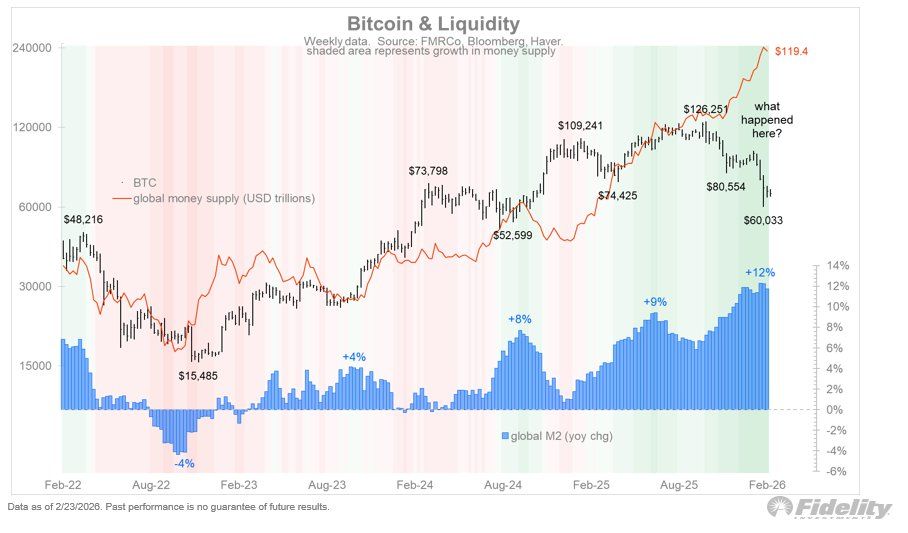
Chart 1: Bitcoin price vs. global money supply showing growing divergence (Source: X/Jurrien Timmer)
The Speculative Component: Why Liquidity Alone Isn’t Enough
Timmer’s analysis reveals that when the speculative component of the market turns negative, it can easily override the liquidity tailwind that would otherwise support Bitcoin. He demonstrated this by adding the rate of change in the software and SaaS index to money supply growth—creating a composite that tracks Bitcoin’s price action far more accurately than liquidity alone.
“Right now, we have ample liquidity growth but a bear market in speculation. The result: Bitcoin is languishing while gold and the money supply are rallying,” Timmer remarked. This observation captures the current market dynamic perfectly. Despite record money printing, risk appetite has evaporated.
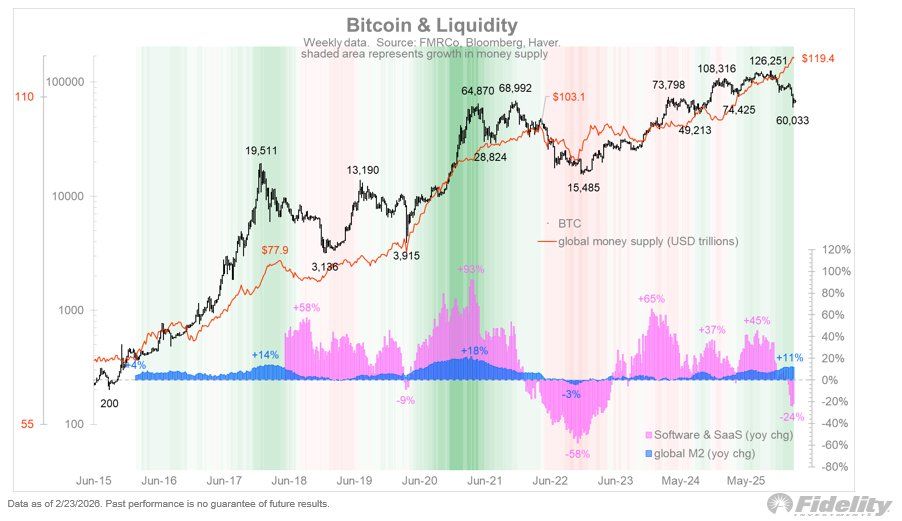
Chart 2: Bitcoin’s price action closely tracks composite of liquidity and tech speculation (Source: X/Jurrien Timmer)
February 2026 has been particularly punishing for Bitcoin. The cryptocurrency is trading near $67,788, down nearly 14% for the month and heading for its fifth consecutive monthly loss—a stark contrast to gold’s resilience. Broader crypto prices have followed suit, with Ether down approximately 17% in February and XRP losing 15%.
The Structural Shift: Why Risk Appetite Has Faded
Multiple factors have contributed to the collapse in speculative appetite. Heightened global geopolitical tensions, uncertainty over the world’s largest economies, and fears of additional U.S. trade tariffs have kept investors largely averse to speculative assets. Even positive catalysts—such as Strategy’s continued Bitcoin purchases—have failed to offset the selling pressure.
Derivatives markets tell the same story. Bitcoin’s two-month futures annualized premium hovers around just 2%, well below the 5% neutral threshold that separates bullish from bearish sentiment. Meanwhile, the 30-day options delta skew remains elevated at 14%, meaning put options (bets on downside) are still significantly more expensive than calls. This indicates that professional traders continue hedging against further declines rather than positioning for upside.
JPMorgan’s Perspective: Volatility-Adjusted Opportunity
Despite Bitcoin’s near-term struggles, some institutional voices see a compelling long-term opportunity. JPMorgan strategist Nikolaos Panigirtzoglou noted that the “large outperformance of gold vs. bitcoin since last October coupled with the sharp rise in gold volatility has left bitcoin looking even more attractive compared to gold over the long term.”
The bitcoin-to-gold volatility ratio has fallen to 1.5—a new record low. On a volatility-adjusted basis, Panigirtzoglou calculated that Bitcoin’s market cap would need to rise to $266,000 to match the private sector’s investment in gold. This suggests that if Bitcoin’s volatility continues to decline as the asset matures, significant upside potential exists.
The Bottom Call: Timmer’s Optimistic Outlook
Despite the current divergence, Timmer has called the recent drop to $60,000 a cycle bottom. “It’s anyone’s guess whether $60,000 is the low, but my guess is that it is, and that after a few months of backing and filling the next cyclical bull market will get underway,” he wrote on X. He pointed to pattern recognition and the mathematical harmony of past cycles as the basis for his optimism.
Timmer also argued that the decline to “only” $60,000 is relatively shallow for a Bitcoin winter, suggesting the asset is maturing. As Bitcoin becomes more institutionalized, volatility dampens and swings become less dramatic. He predicts that after a consolidation period of several months, the next bull market will emerge.
Implications for Investors
The current divergence between gold and Bitcoin carries important lessons. Rising liquidity alone does not guarantee crypto performance when speculative appetite is contracting. Bitcoin’s dual nature means it inherits the vulnerabilities of both hard assets and risk assets—benefiting from the former’s tailwinds only when the latter’s headwinds are absent.
For investors, the path forward depends on whether speculative interest returns to crypto markets. Timmer believes it will, after a period of consolidation. JPMorgan sees compelling long-term value on a volatility-adjusted basis. But for now, the gap between gold and Bitcoin serves as a reminder that in the world of digital assets, liquidity is necessary but not sufficient.
Whether Bitcoin will regain alignment with global liquidity likely depends on the return of the speculative appetite that has characterized previous bull markets. Until then, gold remains the pure play on monetary expansion—while Bitcoin waits for its risk-on credentials to be restored.
Sources: The Kobeissi Letter / Fidelity / JPMorgan / Investing.com / CoinDesk / Gate.io
Disclaimer: This content is for market information only and is not investment advice.





