
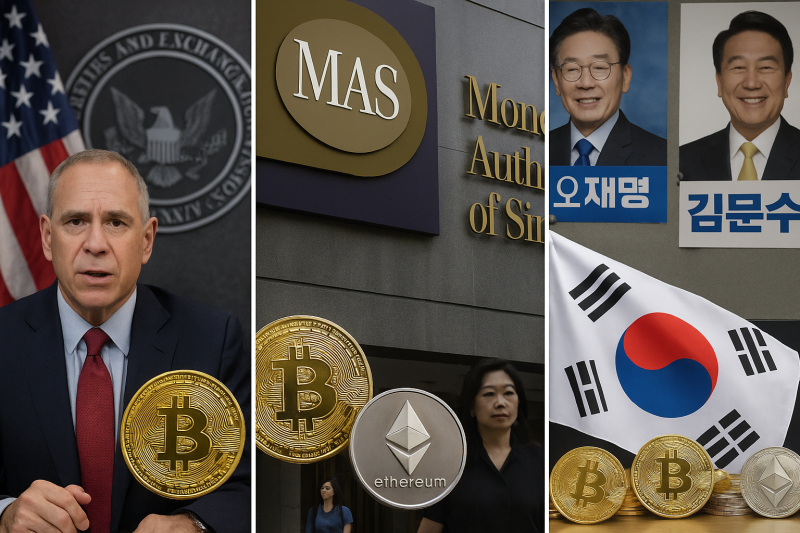
Today’s crypto developments spotlight three major regions — the United States, Singapore, and South Korea — where policy changes and political shifts are shaping the future of digital assets.
SEC Faces Backlash Over New Crypto Staking Guidelines
The U.S. Securities and Exchange Commission (SEC) is under scrutiny after releasing updated guidance suggesting that certain crypto staking services may not qualify as securities. While this potentially exempts proof-of-stake networks from federal registration, critics say the move contradicts earlier legal rulings in high-profile cases.
Former SEC enforcement head John Reed Stark took to X (formerly Twitter), stating the Commission’s decision undermines its mission to protect investors and could conflict with previous court interpretations involving Coinbase and Binance.
“This is a public retreat from regulatory responsibility,” Stark posted, labeling the shift as “a disgraceful departure from investor protection.”
Commissioner Caroline Crenshaw also voiced concern, arguing the staff’s views don’t align with case law or the traditional Howey test used to determine securities status.
The SEC’s Shameful Abdication of its Investor Protection Mission Continues (So This is How The SEC Dies — In Plain View)
This past week, the SEC’s Division of Corporation Finance proclaimed that crypto-related “staking-as-a-service” products were not securities, even though… pic.twitter.com/PzeZilyYHz
— John Reed Stark (@JohnReedStark) June 1, 2025
Singapore Cracks Down on Overseas Crypto Services
Singapore’s central bank has issued a directive requiring all local crypto service providers to cease their overseas operations by June 30, unless they obtain proper licensing. The decision stems from the Monetary Authority of Singapore’s final framework under its Financial Services and Markets Act.
Under Section 137 of the act, even if crypto activities are conducted outside of Singapore, businesses registered in the country must comply or face fines of up to $200,000 and possible imprisonment.
The regulation aims to close regulatory loopholes and ensure a tighter grip over the nation’s digital finance sector.
South Korea’s Election Favors Crypto Either Way
With presidential elections slated for June 3, South Korea’s crypto industry stands to gain regardless of who wins. Both major candidates — Lee Jae-myung of the Democratic Party and Kim Moon-soo of the People Power Party — have promised to loosen crypto regulations and support exchange-traded funds.
Lee has proposed allowing the country’s massive national pension fund to invest in crypto and suggested creating a won-backed stablecoin. Meanwhile, Kim supports wider adoption and regulatory easing.
South Korea continues to be one of the most active crypto markets globally, with daily exchange volumes often surpassing those of its stock markets. Over 16 million citizens are currently participating in the crypto ecosystem.





