
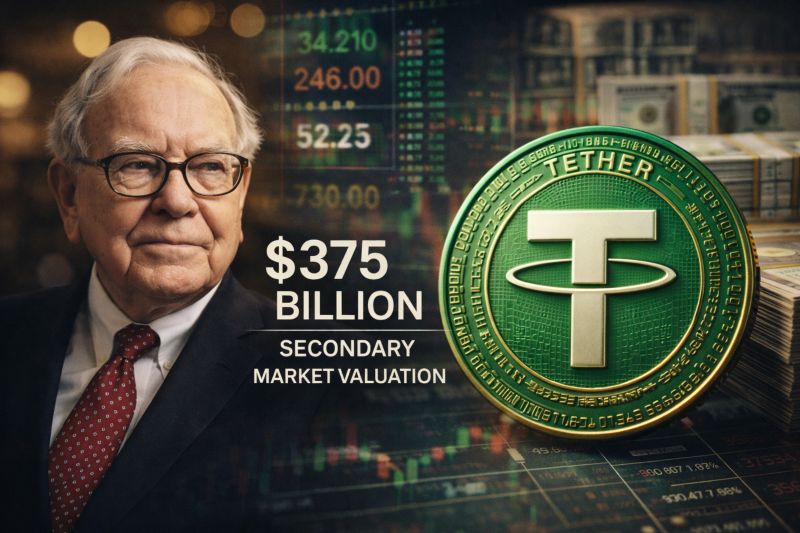
Coin Newsweek – February 27, 2026 – Tether, the company behind the world’s largest stablecoin USDT, is commanding staggering valuations in secondary market trading that could propel its largest shareholder into the upper echelons of global wealth—potentially surpassing even Warren Buffett. According to Forbes, secondary market transactions suggest Tether could be valued at as high as $375 billion, a figure that would place its owners among the richest people on the planet.
Industry sources indicate that Tether shares are changing hands in the secondary market at valuations ranging from $350 billion to $375 billion. These private transactions, typically involving accredited investors and institutional players, provide a real-time window into how market participants value the controversial yet immensely profitable stablecoin issuer.
Based on conversations with cryptocurrency investors and executives, Forbes currently estimates Tether’s valuation at approximately $200 billion—a fourfold increase from the $50 billion valuation assigned just one year ago. This dramatic appreciation reflects Tether’s growing dominance in the stablecoin market and its extraordinary profit-generating capabilities.
The Wealth Behind Tether
Using the $200 billion valuation baseline, Forbes has calculated the implied net worth of Tether’s key shareholders. Chief Financial Officer Giancarlo Devasini, who holds approximately 44-45% of the company’s shares, would command a net worth of about $89 billion. This staggering figure would place him among the world’s wealthiest individuals, though still trailing the very top tier of global billionaires.
CEO Paolo Ardoino and former CEO Jean-Louis van der Velde each hold approximately 19% of the company, translating to a combined net worth of about $38 billion per individual. General Counsel Stuart Hoegner, with an approximate 12% stake, would be worth nearly $25 billion under this valuation scenario.
However, if secondary market pricing proves more accurate, the wealth figures become even more extraordinary. Using the lower end of the secondary market range at $350 billion, Devasini’s stake would be worth over $156 billion. This amount would not only place him among the world’s top ten richest people but would specifically surpass Warren Buffett’s current net worth of $147.8 billion, according to Forbes’ real-time billionaire rankings.
At the high end of the secondary market range—$375 billion—Devasini’s holdings would approach $169 billion, potentially positioning him as one of the five wealthiest individuals globally.
The Valuation Gap: Why Such Different Numbers?
The significant discrepancy between Forbes’ $200 billion estimate and the $350-375 billion secondary market range reflects the inherent challenges in valuing privately held companies with unique business models. Tether is not publicly traded, and its financial disclosures have historically been limited, creating information asymmetry that can lead to divergent valuations.
Secondary market transactions, while providing real-time pricing signals, involve relatively small volumes and may not reflect what a buyer would pay for the entire company. Additionally, these transactions often include minority stakes that trade at premiums or discounts to enterprise value based on liquidity considerations and control provisions.
Forbes’ methodology, which incorporates conversations with investors and executives alongside analysis of Tether’s disclosed financials, represents a more conservative approach that may not fully capture the premium that strategic buyers might assign to Tether’s unique market position and cash flow generation.
Tether’s Extraordinary Profit Machine
The astronomical valuations reflect Tether’s remarkable financial performance. As the issuer of USDT—the most widely used stablecoin in cryptocurrency markets—Tether has benefited enormously from rising interest rates and growing demand for dollar-denominated digital assets.
Tether invests the reserves backing its stablecoins in interest-bearing assets, primarily US Treasury bills. With over $140 billion in USDT in circulation and interest rates at multi-decade highs, Tether’s earnings have reached levels that traditional financial institutions can only dream of. In 2025 alone, Tether reportedly generated profits exceeding $10 billion, making it one of the most profitable companies in the world on a margin basis.
This profit machine shows no signs of slowing. As cryptocurrency markets expand and USDT maintains its dominant position, Tether’s earnings power continues to grow, justifying valuations that place its owners in competition with the world’s most established billionaires.
The Warren Buffett Comparison
The prospect of Tether’s largest shareholder surpassing Warren Buffett’s net worth carries symbolic weight. Buffett, the legendary investor known as the “Oracle of Omaha,” built his fortune through decades of value investing, acquiring companies with durable competitive advantages and holding them for the long term. His Berkshire Hathaway conglomerate owns dozens of businesses across insurance, railroads, utilities, and consumer goods.
Tether, by contrast, has built its wealth in just a few years through a single product operating in a nascent industry. The comparison highlights the extraordinary wealth-creation potential of the cryptocurrency sector, where fortunes can be made—and lost—far faster than in traditional industries.
Buffett himself has been famously skeptical of cryptocurrencies, once describing Bitcoin as “probably rat poison squared.” The possibility that a stablecoin issuer’s shareholder could exceed his net worth would represent a poetic irony that crypto enthusiasts are unlikely to miss.
Implications for the Crypto Industry
Tether’s soaring valuation has broader implications for the cryptocurrency ecosystem. As the company’s private market value climbs, it gains increased credibility and financial firepower to invest in adjacent businesses, acquire competitors, or expand its product offerings. Tether has already begun diversifying into areas like Bitcoin mining, AI infrastructure, and education initiatives.
The wealth creation for Tether’s executives also positions them as major potential investors in the broader crypto economy. With billions in personal wealth tied to the company’s success, Tether’s leadership has both the incentive and the capital to support projects and infrastructure that strengthen the USDT ecosystem.
However, the valuation disparity also highlights ongoing skepticism about Tether’s operations. Critics have long questioned the composition of Tether’s reserves and the adequacy of its audits. While the company has taken steps to improve transparency, including regular attestations of its reserve holdings, doubts persist in some corners of the market.
What Comes Next
Whether Tether will ever realize its secondary market valuation through a public listing remains uncertain. The company has not indicated any immediate plans for an initial public offering, and its executives have shown little interest in the increased scrutiny that comes with public markets.
For now, Tether continues to operate as a private company, its owners enjoying the extraordinary wealth generated by the world’s most widely used stablecoin. Whether Giancarlo Devasini ultimately surpasses Warren Buffett on the rich list depends on which valuation ultimately proves accurate—and whether Tether can maintain its dominant position in an increasingly competitive stablecoin landscape.
As one industry executive noted, “Tether is the most profitable business in crypto, and possibly one of the most profitable businesses in the world relative to its headcount. The valuations, whether $200 billion or $375 billion, reflect that reality.”
Sources: Forbes / Secondary market trading data / Industry sources
Disclaimer: This content is for market information only and is not investment advice.





