

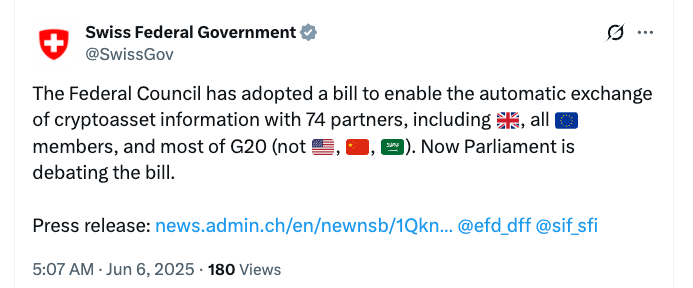
The Swiss government has taken a major step to enhance financial transparency by planning to automatically share tax data related to crypto assets with 74 countries. On June 6, 2025, the Federal Council approved a bill expanding the existing Automatic Exchange of Information (AEOI) system to include digital assets and submitted it to Parliament. This proposal extends the current framework, which is limited to bank accounts, to also cover crypto assets. As part of this decision, Switzerland plans to share crypto tax information automatically with a total of 74 countries, including the United Kingdom and all European Union member states.
Contents and Technical Details of the Bill
The Federal Council sent the proposed legislation to Parliament on February 19, 2025. If passed, it will take effect on January 1, 2026. The regulation will require crypto asset service providers (crypto exchanges, custodial wallet operators, etc.) to collect their clients’ account and transaction data and report it to the Swiss Federal Tax Administration. This data will then be automatically shared with the tax authorities of the partner countries.
The term “crypto asset” is broadly defined in the draft. In line with the OECD’s Crypto-Asset Reporting Framework (CARF), all forms of digitally represented value secured by distributed ledger or similar technology are considered crypto assets. Cryptocurrencies, stablecoins, and tradable tokens (NFTs) fall under this scope, while central bank digital currencies (CBDCs) and non-investment digital assets are excluded.
Crypto service providers in Switzerland will now be required to tighten customer identification and reporting processes. The CARF obliges them to determine users’ tax residency and verify Tax Identification Numbers (TIN). Transactions like fiat-to-crypto, crypto-to-crypto, or wallet transfers will be reportable. Providers must register with the Swiss tax authority by year-end. Non-compliance with obligations may result in penalties.
A two-stage consultation process was carried out in 2024. The draft legislation was opened to public comment in May, and the draft list of partner countries was reviewed in August. After feedback from industry stakeholders, the finalized bill was submitted to Parliament in early 2025. If adopted, the automatic exchange regime for crypto assets will enter into force on January 1, 2026.
Included and Excluded Countries
All EU member states and the United Kingdom are included. In addition, G20 nations like India, Japan, Canada, Brazil, South Korea, and Australia are part of the agreement. However, the United States, China, and Saudi Arabia are excluded from this initial round.
The Swiss government clarified that only countries meeting OECD transparency and data protection standards would be included. The U.S. is excluded due to its separate FATCA system, while China and Saudi Arabia have not yet met the required data protection standards.
Effective Date and First Data Exchange
If approved, the bill will take effect on January 1, 2026. Crypto providers in Switzerland will begin collecting data from that point, with the first international exchange of information planned for 2027.
Before the first exchange, the Swiss government will review whether partner countries still meet the necessary criteria. The existing audit mechanism for financial account AEOI will be extended to crypto data exchanges as well.
Alignment with EU and OECD Standards
The European Union integrated the OECD’s CARF framework into its legislation through the DAC8 directive. EU member states will implement similar reporting obligations starting January 1, 2026. Switzerland is aligning its schedule with the EU to ensure regulatory harmony and prevent arbitrage.
Motivations and Expectations
Switzerland aims to strengthen tax transparency and protect its reputation as a responsible financial hub. By addressing risks of tax evasion and money laundering linked to crypto anonymity, the country seeks to ensure fair competition and enhance investor confidence.
Impact on Local Crypto Sector
Swiss crypto service providers will face new obligations such as customer verification, transaction tracking, and reporting. These requirements may impose extra costs, especially for smaller firms, while larger institutions may adapt more easily. Violations will be subject to penalties.
Official Announcements and Global Reaction
The Swiss government shared details of the decision through official channels and social media, highlighting that the U.S., China, and Saudi Arabia were not included. The move received broad coverage in international media. Countries like India welcomed the decision as a step against offshore crypto-based tax evasion. Switzerland’s initiative may serve as a model for global crypto transparency efforts.





