
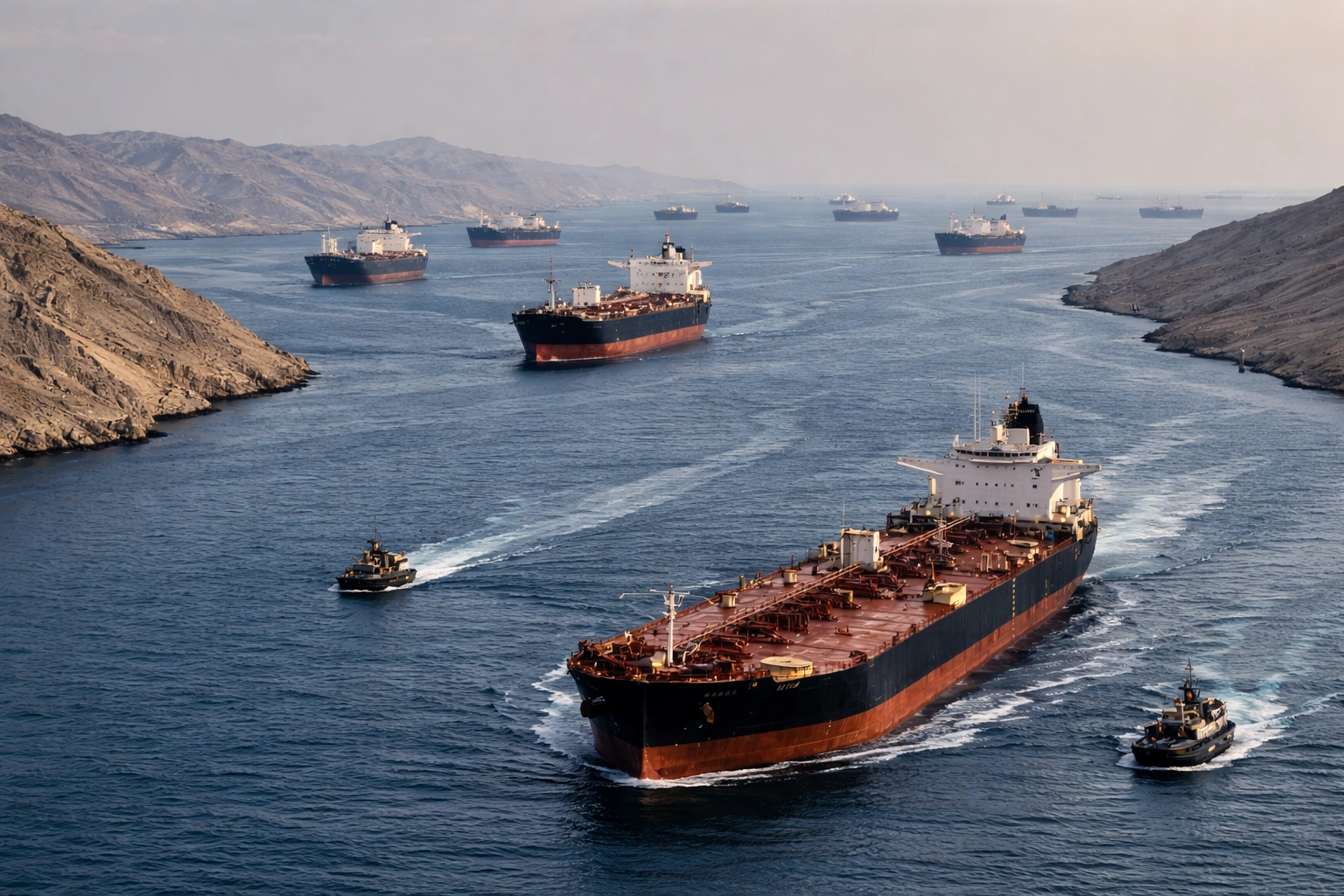
Coin Newsweek – March 3, 2026 – The effective closure of the Strait of Hormuz following US-Israeli strikes on Iran has triggered an unprecedented energy supply crisis, with Asian economies bearing the heaviest burden as tanker traffic through the world’s most critical oil chokepoint grinds to a halt.
The cost of hiring a supertanker to ship oil from the Middle East to China surged to an all-time high of over $423,000 per day on Monday, doubling from Friday’s levels, according to LSEG data. Iran’s Revolutionary Guard Corps declared the Strait closed and warned it would fire on any vessel attempting passage, effectively shutting the corridor through which approximately 20-25% of global oil consumption (over 20 million barrels per day) and one-third of the world’s LNG transits.
Commercial Traffic at a Standstill
The disruption follows the killing of Iran’s Supreme Leader Ayatollah Khamenei in joint US-Israeli strikes on Saturday, which prompted Tehran to launch retaliatory attacks across multiple Gulf states. At least four vessels have been hit in Gulf waters, and major shipping companies have effectively withdrawn from the corridor.
Global shipping giants including Maersk, Hapag-Lloyd, MSC, and Japanese carriers NYK, MOL, and K-Line have suspended all transit through the Strait. Insurance markets have responded in kind, with war risk insurers canceling policies and signaling premium increases of up to 50%. Kpler confirmed that commercial operators have pulled out after insurers withdrew coverage, creating a de facto closure with only a small number of Iranian and Chinese-flagged vessels continuing to transit.
Asia’s Vulnerability: By the Numbers
Approximately 84% of crude oil and 83% of LNG transiting the Strait in 2024 went to Asian markets, according to the US Energy Information Administration. China, India, Japan, and South Korea alone account for roughly 75% of oil flows through the chokepoint.
A Zero Carbon Analytics report ranks Japan as the most vulnerable nation with a risk score of 6.4, followed by South Korea at 5.3 and India at 4.9. Japan sources 87% of its total energy from imported fossil fuels, while South Korea relies on imports for 81%. Both countries are also heavily reliant on oil and gas, which account for 71% and 78% of their fossil-fuel imports respectively.
Government Responses: Reserves and Contingency Plans
Japan convened a National Security Council meeting to assess the situation, with Prime Minister Sanae Takaichi declaring in Parliament: “We will take every possible measure to ensure the stable supply of energy for our nation.” Japan’s combined public and private petroleum stockpiles cover approximately 254 days of domestic consumption, offering a substantial buffer.
South Korea’s Prime Minister ordered an emergency government-wide response, with the Ministry of Economy and Finance announcing plans to secure oil supplies from outside the Middle East. South Korea holds over 210 days of supply and has prepared a market stabilization program worth at least 100 trillion won ($68.4 billion) ready for deployment if needed.
The LNG Vulnerability: A More Immediate Threat
However, LNG stockpiles tell a different story. Japan has no underground gas storage, and its terminal capacity covers just over one month of consumption, according to IEA data. South Korea faces a similar LNG vulnerability. A prolonged Strait closure would make gas shortages a more immediate threat than oil for both countries, given LNG’s critical role in power generation.
Kpler’s analysis adds that India faces the most acute near-term exposure and is likely to pivot immediately toward Russian crude, while China—which recently moderated Russian crude intake—will likely abandon that restraint if the conflict extends.
Oil Price Trajectory: Divergent Forecasts
Brent crude settled around $78 per barrel on Monday, up roughly 9% from Friday’s close, with analysts’ projections diverging sharply depending on the duration of the disruption.
Morgan Stanley estimates that if the conflict extends beyond 25 days, Gulf producers could be forced to shut in up to 16 million barrels per day of exports, potentially pushing Brent toward $100-120 per barrel. JPMorgan’s analysis suggests that Gulf oil-exporting nations have approximately 22 days of storage capacity, with an additional 3-4 days available from floating storage. Beyond this window, production shutdowns become inevitable.
The closure creates a dual supply shock—halting current exports while stranding OPEC’s spare capacity behind the blockade. Bypass options are limited. Saudi Arabia’s East-West pipeline and the UAE’s Abu Dhabi pipeline together offer roughly 3.5 million barrels per day of unused capacity—less than 20% of a full closure, according to Rystad.
Macroeconomic Implications: Inflation and Rate Policy
Capital Economics estimates that if oil prices were to reach $100 per barrel, global inflation would rise by 0.6-0.7 percentage points. For the United States, ING economists calculate that $100 oil could push CPI from January’s 2.4% to above 4%, potentially derailing Fed rate cut expectations.
Moody’s Analytics warns that “higher commodity prices would raise consumer and producer inflation, potentially forcing central banks to pause their easing cycles or even raise policy rates.” Asian importers face the additional burden of weakening trade balances and currency pressure as import costs soar.
The crisis also threatens to destabilize economies already under stress. Moody’s notes that the surge in energy and food prices after Russia’s invasion of Ukraine played a key role in the crises in Sri Lanka, Bangladesh, and Pakistan. “A sustained disruption to Gulf oil exports or maritime traffic could revive debt concerns.”
Taiwan’s Precarious Position
Taiwan faces perhaps the most immediate vulnerability. The island imports more than 96% of its energy, with approximately 60% of its oil and one-third of its LNG arriving via the Strait of Hormuz. While oil reserves can last about 120 days, natural gas supplies would last only 11 days, according to the Taiwan Institute of Economic Research.
This poses a direct threat to the global semiconductor supply chain, as TSMC and other chip manufacturers depend on uninterrupted electricity. Major tech companies maintain backup generators for short-term emergencies, but a prolonged gas shortage could disrupt production of the world’s most advanced computer chips.
The Long View: Accelerating Energy Transition?
While immediate responses focus on securing alternative supplies and drawing down reserves, analysts see the crisis potentially accelerating Asia’s energy transition. Asia Times reports that sustained instability in the Middle East “would tend to alter capital allocation. If Gulf supply carries a persistent geopolitical surcharge, renewables and storage become tools of macroeconomic stabilization.”
India’s aggressive solar targets, once framed in climate terms, now become a balance-of-payments strategy. South Korea’s battery manufacturing and hydrogen technology development could receive renewed state backing as insurance against recurrent energy shocks.
However, this structural shift will take years. In the immediate term, the region faces a scramble for energy supplies and a test of strategic reserves designed for precisely such contingencies. With Iran declaring “total war” on Israel and the US, and President Trump indicating strikes could continue for weeks, the Strait of Hormuz crisis has become the defining geopolitical event of early 2026—with consequences that will ripple through Asian economies for years to come.
Sources: LSEG / EIA / Kpler / Morgan Stanley / JPMorgan / Rystad Energy / IEA / Zero Carbon Analytics
Disclaimer: This content is for market information only and is not investment advice.





