
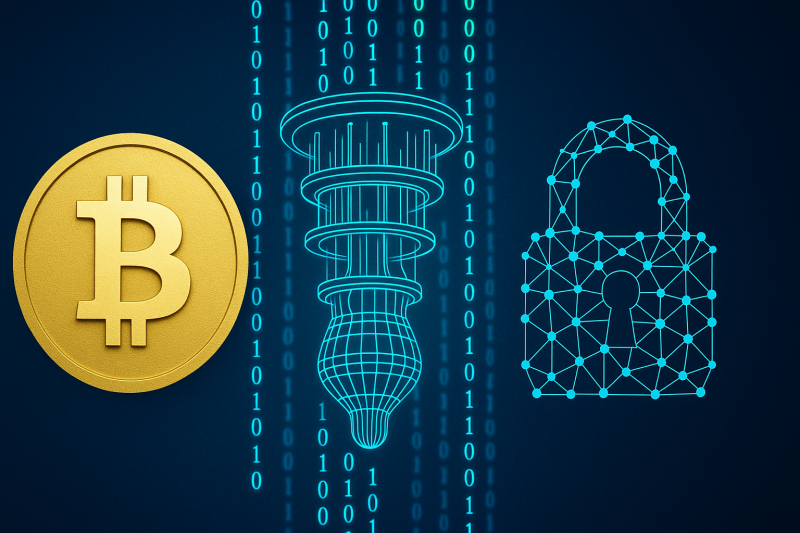
Quantum Threat and the Importance of the 21 Million Supply Cap
Bitcoin’s total supply is capped at 21 million BTC, one of the network’s most fundamental principles. Strict adherence to this limit makes Bitcoin a store of value with digital scarcity. However, two major challenges loom on the horizon: the threat of being cracked by future quantum computers and the demand to extend Bitcoin’s use across different blockchains. The first threat targets Bitcoin’s current cryptographic infrastructure (particularly the ECDSA signature algorithm), while the second arises from the need to use Bitcoin effectively in cross-chain financial ecosystems.
Although the ECDSA algorithm is currently considered extremely secure, a sufficiently powerful quantum computer could theoretically break classical cryptography. Older addresses with publicly visible public keys on the blockchain could become vulnerable to quantum techniques like Shor’s algorithm, which could derive private keys. This puts dormant BTC balances—those that haven’t been transacted for years and have exposed public keys—at risk of quantum theft. In fact, even during a major investment fund application in 2025, this risk was highlighted, with institutional investors warned that quantum technology could break Bitcoin’s cryptography and undermine the network’s integrity.
Experts predict that the computers needed for such a breach could emerge within 10-20 years (some pessimistic estimates suggest an even shorter timeframe). In short, the clock is ticking for the Bitcoin network. On the other hand, Bitcoin holders and developers want to use their BTC across different platforms. There is demand for Bitcoin liquidity in areas like DeFi, NFT marketplaces, or alternative Layer-1 smart contract networks. Until now, wrapped Bitcoin (WBTC) derivatives have been used to meet this need. However, solutions like WBTC rely on a custodian locking up real BTC and minting equivalent tokens on another chain, which introduces trust and custody risks.
From a supply limit perspective, these approaches must adhere to the promise of “1 token minted for every 1 BTC.” Otherwise, replicating Bitcoin across different chains could undermine the scarcity principle by making the total circulating supply uncertain. This is where QRAMP (Quantum-Resistant Asset Mapping Protocol), proposed by Bitcoin developer Agustin Cruz in early 2025, comes into play. QRAMP aims to future-proof Bitcoin against quantum attacks while securely extending it to other chains—without compromising the 21 million supply cap or requiring users to trust centralized custodians.
What is QRAMP? What Approach Does It Propose?
QRAMP, or “Quantum-Resistant Asset Mapping Protocol,” is an innovative framework proposed for Bitcoin. It aims to keep Bitcoin secure in a post-quantum world while enabling Bitcoin assets to be used as synthetic assets in other blockchain ecosystems. Unlike wrapped BTC solutions, QRAMP does not require a centralized custodian, and real BTC never leaves its native chain.
Think of QRAMP as a “Bitcoin hologram”: while your Bitcoin remains locked on the original chain, a cryptographically verifiable reflection of it can appear and be used on different blockchains simultaneously. This reflection (synthetic BTC) is pegged 1:1 to the original and is backed by the original BTC’s proof in the timechain. QRAMP thus operates by creating a shadow of Bitcoin on other platforms without physically moving it.
Another innovation of QRAMP is its use of advanced cryptographic methods. Zero-knowledge proofs (like ZK-SNARKs) can be integrated to allow users to verify Bitcoin ownership or transactions without revealing sensitive information. For example, if a user wants synthetic BTC on another chain in exchange for locked BTC, QRAMP can prove via ZK proofs that the user owns and has locked that BTC—ensuring both privacy and a 100% peg to real BTC.
In summary, QRAMP makes Bitcoin workable on Layer-2 networks, alternative Layer-1 blockchains, or future post-quantum blockchains while maintaining a cryptographic link to Bitcoin’s main chain. It is a comprehensive protocol that combines proactive defense against quantum risk with a secure bridge for cross-chain expansion—all while prioritizing Bitcoin’s supply limit and trust model.
QRAMP’s Technical Mechanism: Burning, 1:1 Conversion, and Proofs
QRAMP requires a hard fork (a mandatory protocol upgrade) to be implemented. This update adds a mandatory address migration mechanism to counter quantum risk. The technical workflow is as follows:
- Identifying Risky Addresses: First, Bitcoin addresses vulnerable to quantum attacks are identified—particularly older ECDSA addresses with exposed public keys. QRAMP scans and flags these at-risk addresses.
- Burn & Replace: Users with BTC in risky addresses send their funds to a designated “quantum burn address.” Burning means these coins become unspendable—permanently removed from circulation. Simultaneously, the protocol mints an equal (1:1) amount of new quantum-resistant BTC for the user.
- Post-Quantum Secure Addresses: The newly issued BTC is secured with quantum-resistant cryptography instead of traditional ECDSA. Two main approaches under discussion are lattice-based cryptography (e.g., NIST finalists like CRYSTALS-Dilithium or Falcon) and hash-based signature schemes (e.g., SPHINCS+ or XMSS).
- Proof-Based Verification: QRAMP enforces cryptographic proof validation for all burn and conversion processes. Users must prove that the burn transaction occurred and that the BTC is truly unspendable. These proofs can be SPV proofs, Merkle proofs, or even ZK-SNARKs for enhanced privacy.
This process effectively forces a network-wide migration to quantum-secure addresses. If QRAMP succeeds, all BTC balances will be moved from weak old addresses to secure new ones. A critical detail: since QRAMP activates via a protocol update, everything follows a strict timeline. After a certain block height, transactions from old ECDSA addresses will be rejected—meaning users who don’t migrate in time risk permanently losing access to their BTC.
21 Million Limit and Synthetic BTC: Is the Supply Preserved?
A key question for the Bitcoin community is: “Does creating synthetic BTC and mirroring them across chains break the supply cap?” QRAMP assures that the core Bitcoin supply does not expand. The protocol neither mints new BTC nor locks up BTC with custodians. Instead, every synthetic BTC is backed by a real BTC that has been burned and disabled on the main chain. Thus, for every 1 BTC made unspendable, at most 1 synthetic BTC can exist elsewhere—maintaining a strict 1:1 cryptographic peg.
This mechanism ensures no fractional reserve or supply inflation. While synthetic BTC circulating on multiple chains might create an illusion of abundance, they are all reflections of the same fixed pool on the main chain. QRAMP thus upholds Bitcoin’s 21 million hard limit while enabling liquidity across platforms.
Note: Due to QRAMP’s forced migration mechanism, old BTC that isn’t moved in time will be burned—potentially reducing the total supply below 21 million. This is a trade-off to protect the network from systemic quantum risk.
Bitcoin on Different Chains: Synthetic BTC Bridges
QRAMP offers a novel alternative to current cross-chain Bitcoin solutions like WBTC. Unlike WBTC, which relies on a custodian, QRAMP uses mathematical proofs. When BTC is burned or locked on Bitcoin’s main chain, this event becomes verifiable on other blockchains. For example, an Ethereum smart contract can validate a Bitcoin transaction (e.g., 5 BTC sent to a QRAMP burn address) using Merkle or SPV proofs, then mint 5 synthetic BTC for the user.
This model has several advantages:
- Custodian-Free Security: No need to trust centralized entities—only cryptographic proofs.
- Transparent Supply: Synthetic BTC in circulation always matches the locked BTC on the main chain.
- Post-Quantum Compatibility: QRAMP allows Bitcoin to integrate with future quantum-secure blockchains without changing its core.
Other Platforms’ Quantum Resistance Strategies vs. QRAMP
QRAMP is one of the most radical proposals to counter quantum risk in Bitcoin, but other projects are also preparing:
- Ethereum: Researching post-quantum wallets via account abstraction (e.g., XMSS, SPHINCS+), but implementation remains theoretical.
- QRL (Quantum Resistant Ledger): A standalone blockchain built with quantum resistance from the start (using XMSS).
- Solana: Offers optional “Quantum Vaults” using one-time signatures (Winternitz OTS).
QRAMP stands out by mandating a network-wide upgrade, unlike these optional or standalone approaches.
Social and Technical Challenges
QRAMP faces significant hurdles:
- Hard Fork & Consensus: Requires broad agreement, risking chain splits if miners or users reject it.
- Dormant Wallets: Addresses like Satoshi’s could be permanently locked if not migrated.
- User Education: Non-technical users must move funds within a deadline or lose access.
- Security Risks: New cryptographic algorithms must be flawlessly integrated.
QRAMP is a bold proposal to future-proof Bitcoin against quantum threats while expanding its utility across chains—without altering its 21 million supply limit. Whether it gains enough support remains uncertain, but the quantum clock is ticking. Bitcoin’s decisions today will shape its security and adoption a decade from now. If implemented, QRAMP could mark one of crypto’s most significant transformations—but its success hinges on both technical excellence and community consensus.





