
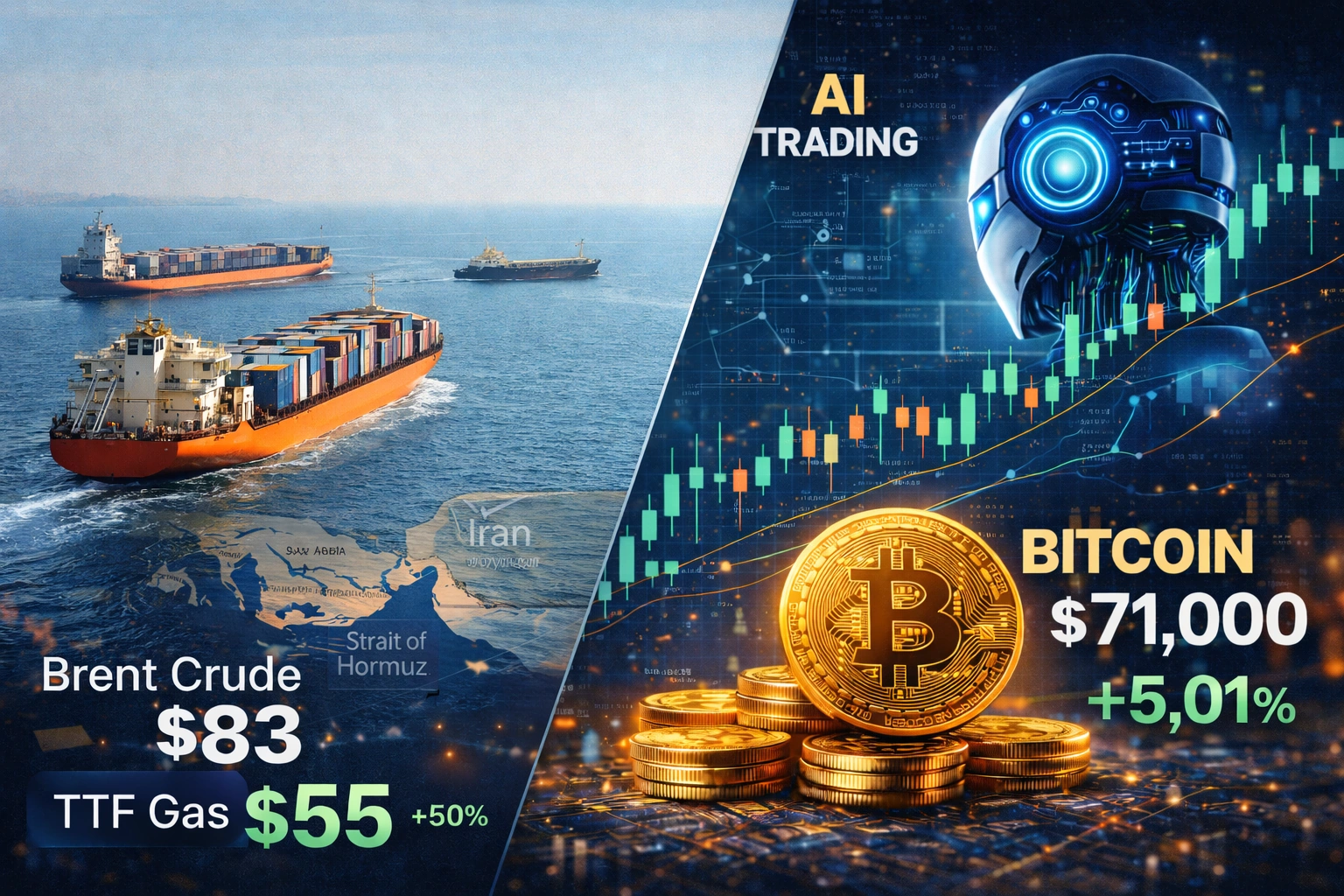
Coin Newsweek – March 4, 2026 – The ongoing closure of the Strait of Hormuz and escalating military exchanges across the Gulf have created one of the most significant energy supply shocks in decades, with ripple effects reaching far beyond oil markets. According to analysis from QCP Markets, the crisis is exposing deep vulnerabilities in the AI and technology supply chain while revealing an unexpected bright spot: Bitcoin’s relative resilience in the face of global turmoil.
The numbers paint a stark picture. Brent crude has surged to approximately $83 per barrel as energy infrastructure suffers damage and shipping through the critical chokepoint grinds to a halt. European natural gas markets have been hit even harder, with Dutch TTF futures skyrocketing 50% to $55, reflecting fears that nearly 20% of global LNG supply is now effectively cut off from international markets.
The Energy Shock: By the Numbers
Goldman Sachs has revised its oil price forecasts sharply upward, now expecting Brent to trade in the mid-$80s during March as markets digest conflicting signals of supply disruption and potential recovery. The bank’s analysts estimate that under their baseline scenario of substantial March disruptions, about 200 million barrels of Middle Eastern crude production could be lost, with OECD commercial inventories projected to fall by approximately 76 million barrels month-on-month.
European gas prices have seen even more dramatic moves. Dutch front-month contracts briefly touched €63.49 per megawatt-hour, the highest level since January 2023, as fears mounted that Qatar’s Ras Laffan plant—the world’s largest LNG export facility—had effectively halted production. The Japan Korea Marker, a key benchmark for Asian LNG, has surged to $25 per million British thermal units, up from just $10.8 on the Friday before the strikes.
The crisis has triggered a cascade of secondary effects. Shipping insurance premiums have spiked dramatically, with reports suggesting that coverage for a $100 million vessel could rise by about 50%, from $250,000 to as much as $375,000 per voyage. Refineries have been attacked and production halted, while shipping insurers have withdrawn coverage, creating a de facto blockade that shows no signs of imminent resolution.
The AI Supply Chain Under Pressure
Perhaps the most significant secondary effect is the strain on technology supply chains, particularly those serving the artificial intelligence sector. South Korea, a global powerhouse in semiconductor manufacturing, has been hit especially hard due to its heavy reliance on imported energy. The KOSPI index has retreated approximately 20% from its recent highs, with major tech components Samsung Electronics and SK Hynix suffering severe losses.
On March 3 alone, Samsung fell 9.88% while SK Hynix tumbled 11.50%, reflecting the market’s recognition that energy-intensive semiconductor production is acutely vulnerable to sustained energy price spikes. The broader KOSPI plunged more than 7% in a single session, and has now retreated about 16-20% from last week’s record highs.
This weakness in Asian tech stocks has dragged down global sentiment, with Japan’s Nikkei 225 and TOPIX indexes falling over 4% each, and the S&P 500 futures sliding nearly 0.4%. The vulnerability of the AI supply chain to energy shocks has become a central concern for investors who had previously treated the sector as largely insulated from geopolitical risks.
Bitcoin’s Unexpected Resilience
Amid the widespread sell-off in traditional risk assets, Bitcoin has emerged as a notable outperformer. QCP analysts highlight that the leading cryptocurrency has shown remarkable resilience compared to equities and other risk-sensitive instruments, potentially serving as an early indicator of stabilizing sentiment.
Following the initial strikes on February 28, Bitcoin experienced a brief dip to $63,000, triggering approximately $300 million in long liquidations. However, the scale of forced selling was relatively contained, suggesting markets were already positioned for volatility. Since then, BTC has rebounded strongly, reclaiming the $66,000 level and demonstrating the ability to hold support even as traditional markets continued to wobble.
“Bitcoin is more resilient than risk assets and may become a leading indicator of stabilizing sentiment,” QCP analysts noted, pointing to the cryptocurrency’s ability to decouple from equity market weakness. This view is supported by derivatives data, which shows that while the bitcoin 30-day annualized implied volatility index remains steady around 58.8%, it hasn’t spiked to panic levels despite the crisis.
The Liquidation Picture: Contained Damage
Despite the severity of the geopolitical shock, crypto derivatives markets have not shown signs of systemic stress. Cumulative futures open interest has dropped only modestly, falling 2% to $93.78 billion, remaining above recent lows. Annualized perpetual funding rates for major cryptocurrencies are little changed or slightly negative, indicating a cautious but not panicked market.
On Deribit, short-term bitcoin puts have traded at an 8-10% volatility premium to calls, reflecting heightened downside concerns, but the $60,000 put remains the most popular trade rather than more aggressive downside bets. This suggests that while traders are hedging, they are not positioning for catastrophic declines.
What Comes Next: The Path Forward
QCP analysts expect short-term volatility to persist, noting that the lockdown’s duration will be critical. “If the lockdown persists, various parties may pressure for reopening,” they note, highlighting that China has already urged Iran to keep the strait open. The global dependence on chips, semiconductors, and AI-driven growth creates powerful incentives for major economies to push for a resolution.
Goldman Sachs outlines several scenarios. Under their baseline, exports through the Strait of Hormuz remain at roughly 15% of normal levels for about five more days before gradually recovering to 70% over two weeks and then returning to full capacity. However, they also warn that risks remain “significantly skewed to the upside,” with lengthier disruptions potentially pushing Brent toward $100 per barrel.
For crypto markets, the key question is whether Bitcoin’s resilience can be sustained. If the cryptocurrency can maintain its relative strength through this period of energy-driven volatility, it could reinforce the narrative that digital assets are maturing into genuine safe havens rather than simply high-beta risk plays. Conversely, a breakdown in Bitcoin’s support levels would suggest that even this supposedly uncorrelated asset remains vulnerable to macro shocks.
The Broader Implications
The Hormuz crisis has exposed the fragility of global supply chains that the tech industry—and particularly the AI sector—has come to depend on. South Korea’s rapid retreat from record highs serves as a warning that even the most promising growth stories can be derailed by energy shocks. For investors who have piled into AI and semiconductor stocks, the lesson is clear: geopolitical risk cannot be hedged away by technological optimism alone.
For Bitcoin, the crisis presents both a challenge and an opportunity. The challenge is navigating a period of heightened volatility and potential risk-off sentiment. The opportunity is demonstrating that after 16 years of existence, the world’s first cryptocurrency can serve as a store of value that holds up when traditional markets falter. Early indications suggest Bitcoin is passing this test, but the crisis is far from over.
Sources: QCP Market / ChainCatcher / Reuters / Bloomberg / CoinDesk
Disclaimer: This content is for market information only and is not investment advice.





