
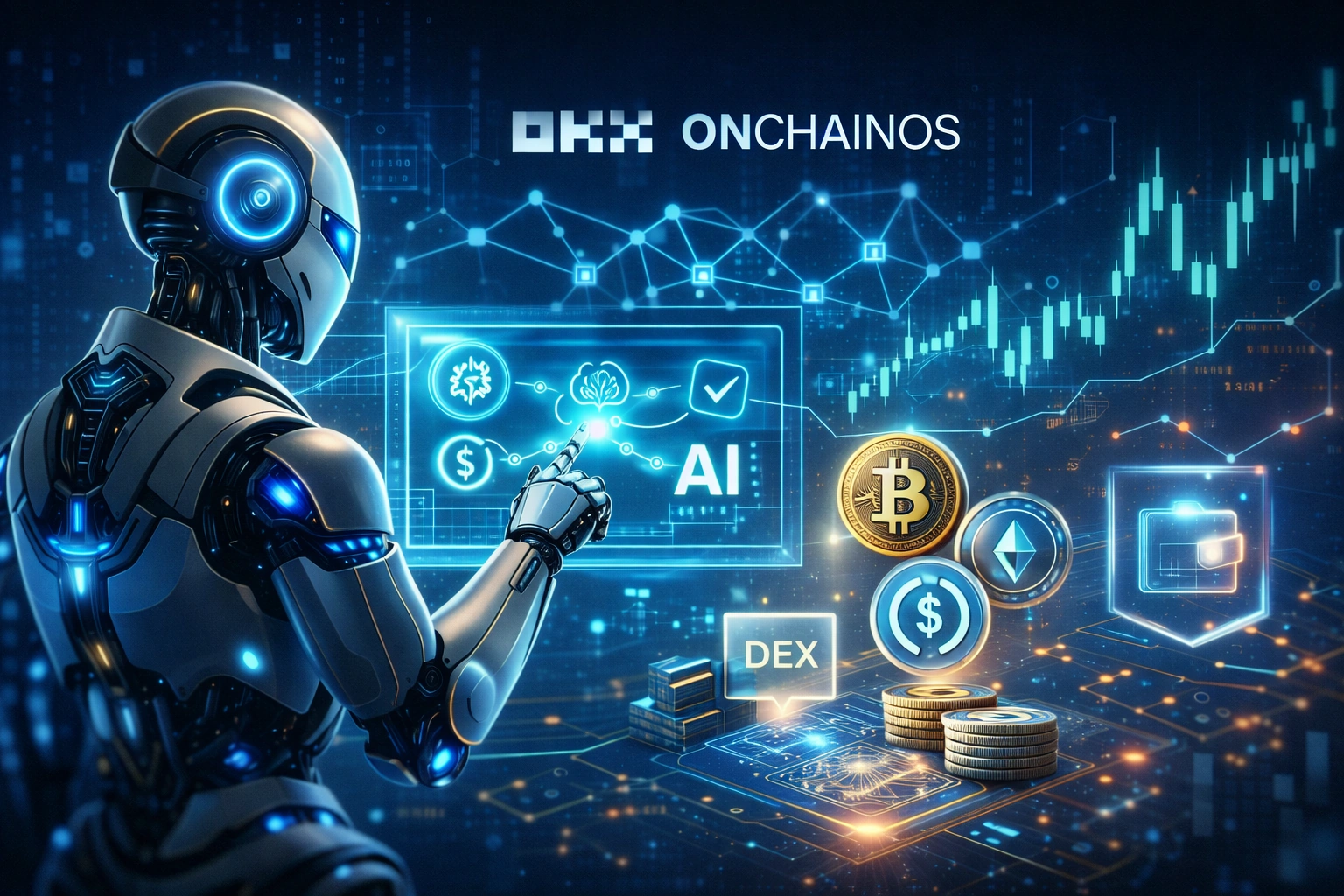
Coin Newsweek – March 4, 2026 – OKX has taken a significant step toward the future of decentralized finance with the launch of a native AI layer on OnchainOS, its developer-focused onchain platform. The new infrastructure is designed to enable AI agents to act autonomously on blockchain networks, bridging the gap between traditional decentralized tooling and machine-native automation for trading, wallet management, payments, and market data access.
The move positions OKX at the intersection of two of the most transformative technologies in the current digital landscape: artificial intelligence and blockchain. By creating a unified framework where AI agents can operate independently, OKX aims to reduce the manual overhead required for complex onchain operations while opening new possibilities for algorithmic trading, liquidity management, and automated portfolio strategies.
What is OnchainOS?
OnchainOS is the onchain toolkit and execution environment built by OKX’s Web3 team, intended to support developers and automated agents across multiple blockchain networks. The platform ties together wallets, real-time market data, trading interfaces, and programmable execution in a single framework that AI agents can call into, creating a cohesive ecosystem for autonomous operation.
Unlike basic smart contract SDKs or standalone APIs that require developers to wire together separate components, OnchainOS allows agents to perform entire workflows—from reading prices to executing transactions—without manual integration. The platform unifies familiar building blocks such as wallet infrastructure, liquidity routing, and onchain data feeds into a comprehensive execution stack.
OKX reports that OnchainOS already supports more than 60 blockchain networks and aggregates liquidity across 500+ decentralized exchanges (DEXs), all while sitting on proven infrastructure that handles billions of API calls and high volumes of trading activity with sub-100ms response times.
Core Capabilities: What the AI Layer Offers
The new AI capabilities are organized into several core modules that developers can build upon:
Wallet Functionality: Agents can query balances, send transactions, and retrieve cross-chain history across supported networks, giving them complete visibility and control over onchain assets.
Autonomous Payments: Using the x402 pay-per-use protocol, agents can initiate and settle transactions without manual intervention. In certain cases, transactions can be executed with zero gas costs on OKX’s X Layer, removing economic barriers to frequent micro-transactions.
Smart Trading: Aggregated routing across hundreds of DEXs enables agents to source the best prices for swaps and execute trades automatically based on predefined parameters or real-time market analysis.
Structured Market Data: Real-time onchain data feeds covering tokens, transfers, trades, and account information help agents make informed decisions about when and how to act, incorporating live market conditions into their logic.
DApp Connect: Direct integration of OKX Wallet into any decentralized application expands connectivity options, allowing agents to interact with the broader DeFi ecosystem seamlessly.
From Simple Instructions to Complex Outcomes
The true power of OnchainOS lies in how these building blocks work together. Simple natural language instructions can produce complex autonomous results. For example, an agent connected to OnchainOS could be instructed to swap ETH for USDC if a specific price threshold is reached. The agent would handle everything from monitoring prices across multiple DEXs to executing the optimal trade onchain—all without further human input.
This capability transforms how developers can approach algorithmic trading, liquidity management strategies, onchain risk monitoring, and dynamic portfolio rules. Previously, building such systems required piecing together separate APIs and data feeds, a time-consuming process that often introduced points of failure. OnchainOS abstracts that complexity into a unified framework.
Three Paths to Integration
OKX offers developers and teams three main ways to integrate with OnchainOS:
AI Skills: Agents interact through human-friendly descriptions of what they want to do, bypassing low-level API wiring. This approach allows developers to focus on agent behavior rather than technical implementation details.
MCP (Model Context Protocol): A direct connection between OnchainOS and AI agent frameworks or LLM applications means that models like Claude Code, Cursor, or OpenClaw can call onchain functionality natively, treating blockchain operations as extensions of their existing capabilities.
Open API: For developers who want detailed programmatic control, direct RESTful access to every capability is available, offering maximum flexibility for custom implementations.
Why This Matters for the Crypto Ecosystem
Agents capable of autonomously operating onchain promise to fundamentally change how users interact with decentralized finance. By reducing manual overhead for trading, arbitrage, portfolio rebalancing, and data-driven decisions, these systems can unlock new levels of efficiency and sophistication.
While existing AI wallets might handle simple tasks like sending tokens or checking prices, OnchainOS focuses on orchestrating multi-step workflows that combine market insight with execution logic—all within a unified system. This could accelerate experimentation in areas previously constrained by technical complexity, including algorithmic trading strategies, automated liquidity management, and real-time risk monitoring.
The scalability and reliability metrics underpinning OnchainOS—including sub-100ms response times and sustained throughput at scale—are foundational to supporting truly autonomous operations over time. Without robust infrastructure, even the smartest AI agents would be limited by the systems they operate on.
The Broader Context: AI and Blockchain Converge
The launch arrives amid growing interest in the intersection of artificial intelligence and blockchain technology. Industry observers have long speculated about the potential for AI agents to operate autonomously on decentralized networks, managing assets, executing trades, and participating in governance without human intervention. OKX’s OnchainOS represents a concrete step toward realizing that vision.
By building on existing wallet and DEX infrastructure, the AI layer leverages proven technology while adding new capabilities. The result is a platform that can support everything from simple automated tasks to complex, multi-step strategies spanning multiple blockchain networks.
What’s Next for OnchainOS
OKX has announced that OnchainOS with the new AI layer is available now to developers worldwide. Comprehensive documentation and starter guides have been published to help builders deploy their first AI agents and decentralized applications using the toolkit.
As developers begin experimenting with the platform, the coming months will likely reveal novel use cases and applications that push the boundaries of what autonomous agents can achieve on blockchain networks. For the broader crypto ecosystem, OnchainOS represents a significant step toward a future where humans and AI collaborate seamlessly in decentralized finance.
Sources: OKX official announcement / OnchainOS documentation
Disclaimer: This content is for market information only and is not investment advice.





