
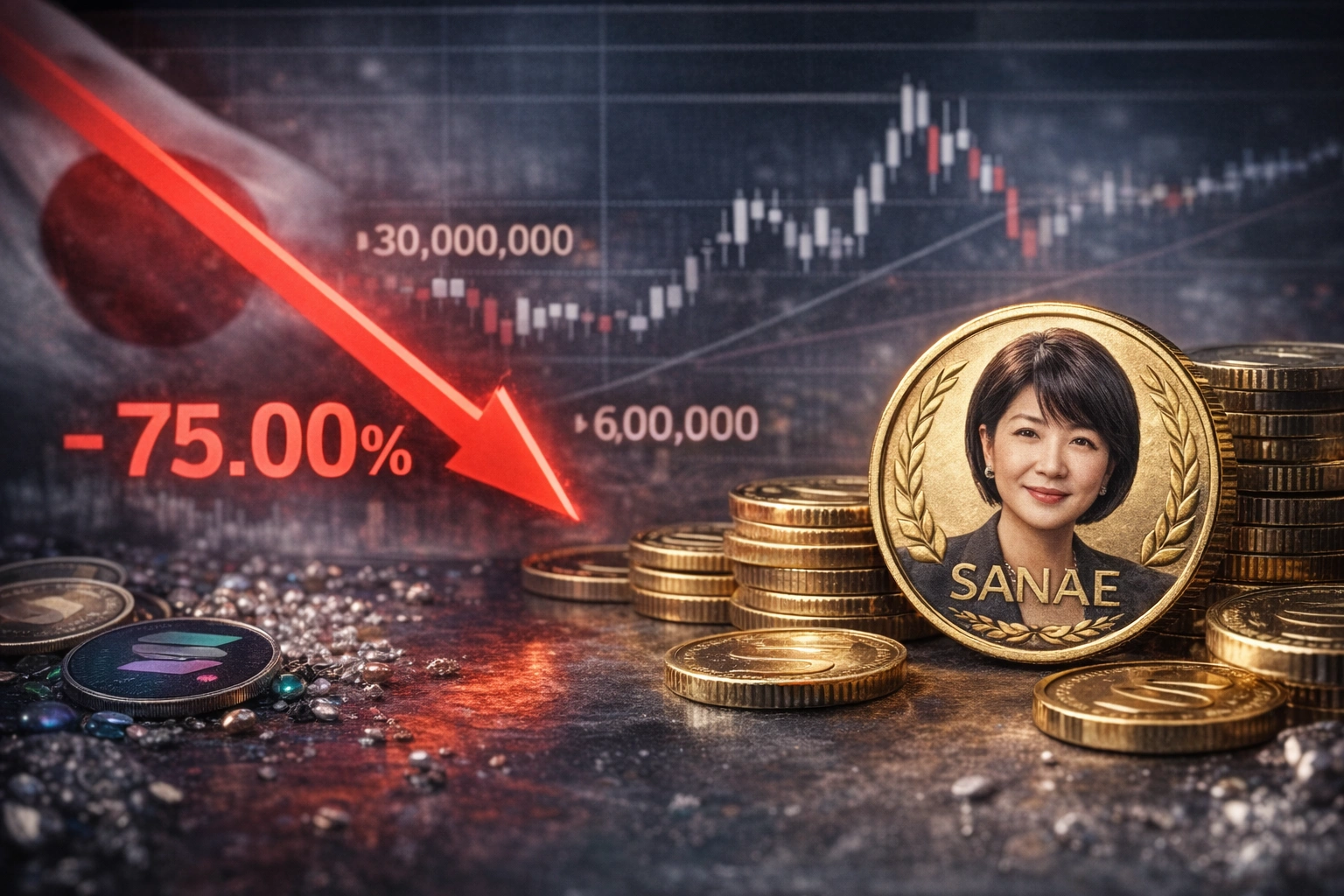
Coin Newsweek – March 3, 2026 – In a bizarre turn of events that highlights the wild west nature of meme coin markets, Japan’s Prime Minister Sanae Takaichi has been forced to publicly deny any involvement with a Solana-based token bearing her name after it skyrocketed to a $30 million market cap and then spectacularly crashed by 75%.
The token, simply named “SANAE,” appeared on the Solana ecosystem approximately six days ago and quickly became a speculative frenzy. Data from GMGN shows the coin briefly touched a market capitalization of $27.72 million before tumbling to its current level of around $6.6 million—a devastating drop that left latecomers nursing heavy losses.

The SANAE token’s dramatic rise and fall: from $30M to $6M in days
Prime Minister Speaks Out: “I Have Absolutely No Knowledge”
As the token gained attention, confusion spread among Japanese and international crypto investors who mistakenly believed the project had official backing. Takaichi, who serves as Japan’s Minister for Economic Security, took to X (formerly Twitter) on Monday to set the record straight with an unusually direct statement.
“I have heard that a cryptocurrency called SANAE TOKEN has been issued and is being traded to some extent,” the Prime Minister wrote. “Due to the name, it seems there are various misunderstandings, but regarding this token, I have absolutely no knowledge of it, nor has my office been informed about what this token entails. We have not given any approval whatsoever in this matter.”
The statement was clearly aimed at “ensuring that the public does not labor under any misapprehensions,” as Takaichi put it—a necessary step given how quickly political figures have been dragged into crypto controversies in recent months.
Concentration Concerns: Top Wallets Control 60%
Blockchain data reveals a troubling picture of the token’s distribution. According to Wu Blockchain, the top three addresses held roughly 60% of the token’s total supply, with several leading wallets recording notable inflows during the pump. Another analysis from BlockBeats shows that the top 10 addresses collectively control 42.6% of the supply—a level of concentration that makes the token highly vulnerable to coordinated dumping.
This isn’t the first time a meme coin inspired by a political figure has caused turmoil. The LIBRA token, which was initially framed as being backed by Argentina’s President Javier Milei, led to political scandal and significant investor losses earlier this year. The pattern is becoming disturbingly familiar: anonymous creators launch tokens named after public figures, ride the wave of speculative buying, and often exit with liquidity before the music stops.
The Anatomy of a Political Meme Coin Crash
What makes the SANAE token particularly noteworthy is its combination of astronomical rise and dizzying fall within days. After peaking at nearly $30 million, the token’s market cap collapsed by roughly 75% in what appears to be a classic “pump and dump” pattern. The token currently trades at around $6.6 million, with on-chain data suggesting continued selling pressure.
This volatility is characteristic of meme coins, which often derive their value from social media hype rather than fundamental utility. But when a token is named after a sitting prime minister who has explicitly denied involvement, the risks become even more pronounced. Investors who bought at the top are now left holding tokens backed by nothing but a politician’s disavowal.
The Bigger Picture: A Growing Pattern
The SANAE incident joins a growing list of meme coin controversies involving public figures. From Donald Trump-themed tokens to the recent PATRIOT coin debacle—which saw a 15-foot gold-plated statue fail to prevent a 90% crash—the intersection of politics and meme coins has proven consistently volatile and often disastrous for retail investors.
In the PATRIOT coin case, internal disputes with a sculptor over intellectual property rights delayed promotional events, while competition from “Official Trump” tokens splintered demand. The result was a classic cautionary tale: even elaborate marketing stunts can’t save a token without genuine community support.
Similarly, the SANAE token’s concentration in a few wallets raises red flags. When a handful of addresses control a large percentage of supply, they can coordinate sell-offs that tank the price—leaving ordinary investors powerless. Takaichi’s swift disavowal, while necessary to protect her reputation, likely accelerated the decline as speculators realized no official support would ever materialize.
What This Means for Investors
The SANAE token saga serves as a stark reminder of the risks inherent in political meme coins. Even a token named after a sitting prime minister can crash 75% in days, especially when the public figure in question has no connection to the project. For investors, the lesson is simple: celebrity and political names alone do not constitute a valid investment thesis.
As one analyst noted, the meme coin space remains a “high-risk gambling environment” where elaborate promotional campaigns can collapse when market sentiment shifts. Takaichi’s forced disavowal may have protected her office from association with the crash, but for those who bought at $30 million, the damage is already done.
The SANAE token now trades at a fraction of its peak, a digital monument to the dangers of assuming that a name alone carries value. Whether any lessons will be learned remains to be seen—but given the pattern of political meme coin crashes, history suggests it won’t be the last.
Sources: CoinDesk / GMGN / Wu Blockchain / BlockBeats
Disclaimer: This content is for market information only and is not investment advice.





