
Coin Newsweek – February 27, 2026 – Ripple has announced a fundamental restructuring of how funding and support are distributed across the XRP Ledger ecosystem, marking 2026 as a transition year toward a more decentralized and multi-channel approach to builder support. The changes, detailed in a February 26 blog post, aim to expand access to capital, mentorship, and technical resources through independent pathways rather than relying on centralized allocation.
Since 2017, Ripple has deployed over $550 million into XRPL ecosystem initiatives, including non-equity grants, builder incentives, strategic partnerships, and growth programs. The new framework represents an evolution from this centralized model toward a broader, more distributed funding structure where builders can access support through multiple independent channels.
“As the ecosystem matures, the focus is shifting toward expanding access to funding through more distributed and independent pathways so builders have multiple avenues to scale,” the company stated in its announcement.
New Initiatives Reshape XRPL Funding Landscape
Central to the transformation is XAO DAO, a hybrid Decentralized Autonomous Organization built specifically for the XRP Ledger. This DAO will empower community members to collectively allocate resources through grants, feedback loops, and direct proposals. The structure enables fast, low-friction funding for developers and early-stage projects while distributing decision-making power across a broader stakeholder base.
“By shifting decision-making power toward a broader group of stakeholders, XAO DAO represents a significant step toward a more resilient and community-led governance model for the XRPL,” Ripple explained.
XRPL Commons, an independent organization already operating in the ecosystem, will continue supporting builders through established initiatives like the GLOW program and The Aquarium—a 9-week Paris-based incubator that has operated since 2023. The organization is also developing XRP Asia, a new regional entity designed to serve the APAC builder community with localized funding and support tailored to the region’s unique market dynamics.
The University Digital Asset Xcelerator (UDAX), which launched its inaugural cohort with UC Berkeley in fall 2025, is expanding significantly in 2026. New partnerships will bring the program to Fundação Getulio Vargas in São Paulo, the University of Oxford, and back to UC Berkeley for a second cohort in the fall.
On the institutional front, Ripple is launching a FinTech Builder Program specifically designed to support startups building institutional-grade financial applications on XRPL. This initiative targets the growing intersection of traditional finance and blockchain infrastructure, positioning XRPL for deeper integration with established financial institutions.
Venture Capital Participation Signals Institutional Confidence
Perhaps the most telling indicator of ecosystem maturity is the growing involvement of venture capital firms. According to Ripple’s announcement, a growing number of VC firms are now mentoring teams, investing in startups, and connecting XRPL builders with global capital networks.
Partner organizations include a100x Ventures, Superscrypt, Reforge, New Form Capital, Dragonfly, Pantera, Franklin Templeton, and Tenity. This roster includes both crypto-native funds and traditional financial heavyweights like Franklin Templeton, suggesting that institutional confidence in XRPL’s long-term potential is broadening beyond the crypto-native investment community.
To streamline access to this expanding ecosystem, Ripple announced that a dedicated XRPL funding hub will soon launch. The platform will serve as a single entry point for builders to discover grants, accelerators, and support programs across the entire ecosystem, reducing friction in the funding discovery process.
XRP Price Action Remains Subdued Despite Structural Progress
The ambitious funding overhaul comes at a time when XRP’s price performance continues to track broader market trends rather than ecosystem-specific developments. Coin Newsweek Markets data shows the altcoin declined 2.24% over the past 24 hours, trading at $1.41 at press time.
This price action reflects a persistent reality in cryptocurrency markets: structural improvements and ecosystem expansion typically take time to translate into price appreciation, and short-term price movement is often dominated by liquidity conditions, macro trends, and regulatory headlines rather than infrastructure developments.
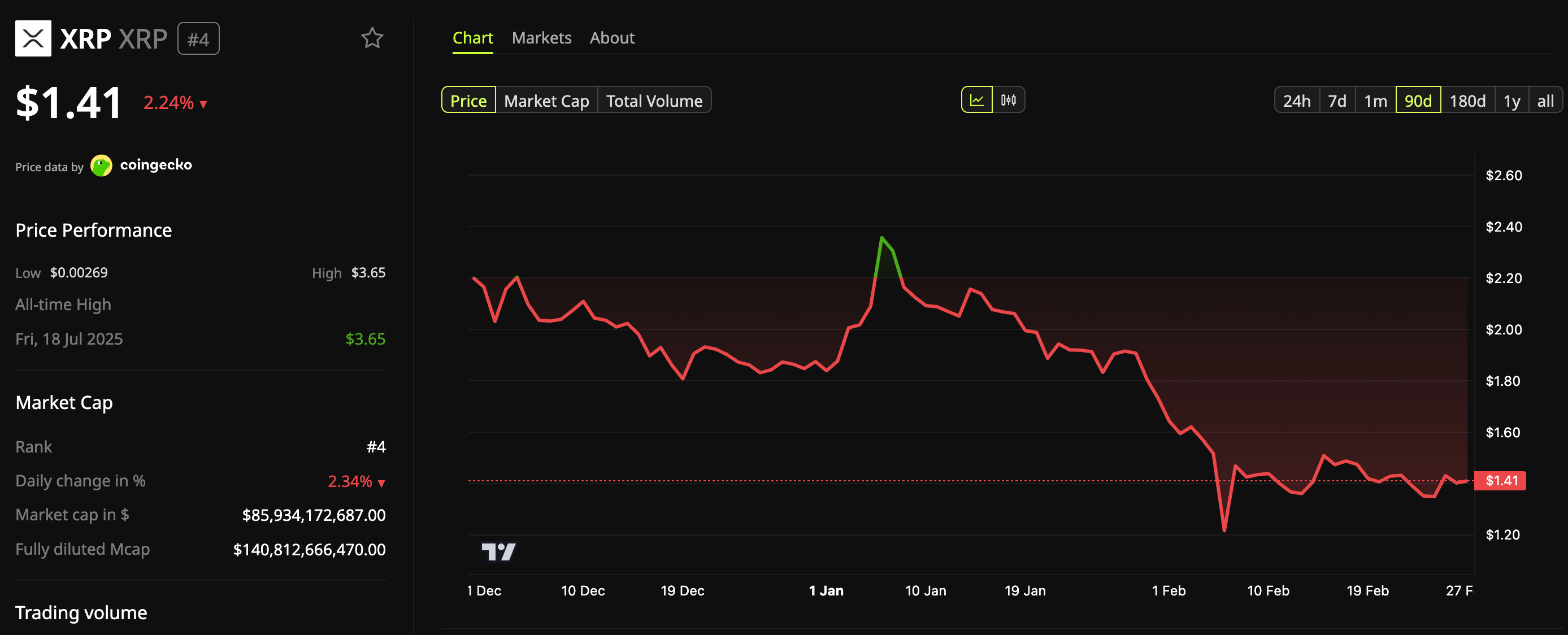
Chart: XRP price performance showing recent trading levels (Source: Coin Newsweek Markets)
Short-Term vs. Long-Term Implications for XRP
In the immediate term, the funding restructuring is unlikely to move XRP’s price meaningfully. Market participants focused on daily trading are more likely to react to regulatory developments, macroeconomic shifts, and broader crypto sentiment than to ecosystem funding mechanisms, however innovative.
Over the medium to long term, however, the impact will depend critically on execution. If the FinTech Builder Program, XAO DAO, and expanded venture participation translate into measurable outcomes—higher on-chain activity, successful institutional pilots, and real-world financial applications built on XRPL—sentiment could strengthen gradually.
The involvement of established VC firms provides one channel for this translation. When funds like Pantera and Dragonfly allocate capital to XRPL projects, they bring not only funding but also operational expertise, network connections, and credibility that can accelerate project development and adoption.
Similarly, the expansion of university programs through UDAX creates a pipeline of talent and ideas that could yield innovative applications over time. The combination of academic research, entrepreneurial energy, and venture funding creates conditions conducive to ecosystem growth, even if the timeline for visible results extends over years rather than months.
What Would Need to Happen for Structural Price Impact?
For the funding overhaul to meaningfully affect XRP’s valuation, several intermediate outcomes would need to materialize. Sustained adoption of XRPL-based applications would need to generate measurable transaction growth and on-chain activity. Deeper integration of XRP into payment flows, tokenization platforms, or institutional financial infrastructure would need to demonstrate real utility.
Usage metrics, not funding headlines, will ultimately determine whether this structural shift supports long-term valuation. If the expanded ecosystem produces applications that drive demand for XRP as a bridge asset, settlement token, or platform currency, the price implications could become significant. Conversely, if the funding translates into activity that doesn’t directly involve XRP, the token may not capture value from ecosystem growth.
The involvement of Franklin Templeton is particularly noteworthy in this context. As a traditional asset manager with $1.5 trillion in assets under management, its participation suggests that XRPL may be positioned to capture institutional interest in tokenization and digital asset infrastructure—areas where XRP’s role remains to be defined but could be substantial.
Conclusion: A Necessary Evolution With Uncertain Price Impact
Ripple’s 2026 funding overhaul represents a necessary evolution for the XRPL ecosystem. By moving toward distributed funding channels, community governance through XAO DAO, and expanded venture participation, the foundation is being laid for more resilient and diverse ecosystem growth.
For XRP holders, the question is whether this structural progress will eventually translate into price appreciation. The answer depends on factors that remain uncertain: the quality of projects that emerge from expanded funding, the pace of institutional adoption, and the extent to which XRP itself captures value from ecosystem activity.
In the near term, XRP’s price will likely continue to track broader market trends and regulatory developments. But over a longer horizon, the success of initiatives like XAO DAO, the FinTech Builder Program, and university partnerships could contribute to the kind of fundamental demand that supports sustained valuation. For now, investors must watch execution, adoption metrics, and usage patterns to assess whether this ambitious restructuring delivers on its long-term promise.
Sources: Ripple official announcement / Coin Newsweek Markets
Disclaimer: This content is for market information only and is not investment advice.





