
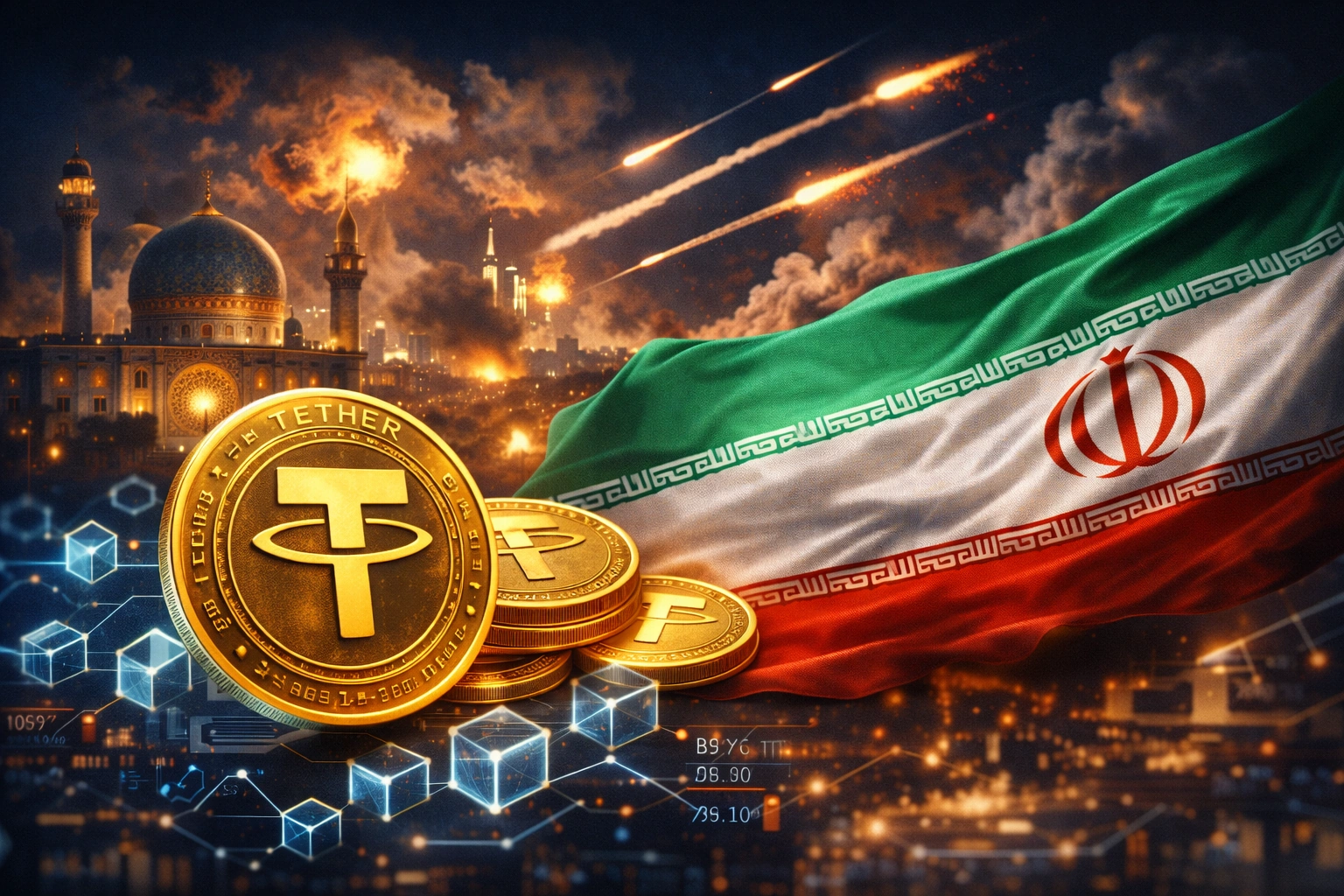
Coin Newsweek – March 4, 2026 – A month before bombs fell on Iran, Reuters reported that the US Treasury was investigating whether crypto platforms had helped Iranian officials evade sanctions. When airstrikes began on February 28, that investigation got a live stress test—and the results were revealing. The war did not break Iran’s crypto infrastructure; it proved how indispensable stablecoins have become to it.
Before the Strikes: A $10 Billion Shadow Economy
In early February, Reuters revealed that Iran’s crypto transaction volumes had reached an estimated $8–10 billion in 2025, citing data from blockchain analytics firms TRM Labs and Chainalysis. Nobitex, Iran’s largest crypto exchange, alone serves approximately 15 million users. But beneath these headline numbers lay a more significant development.
UK-based analytics firm Elliptic told Reuters it had discovered that Iran’s Central Bank acquired at least $507 million in USDT last year—what it described as a “sophisticated strategy to bypass the global banking system.” Chainalysis estimated that half of Iran’s crypto volumes were linked to the Islamic Revolutionary Guard Corps (IRGC). TRM put the figure lower at around 5%, but had still identified over 5,000 IRGC-connected wallet addresses that have moved $3 billion since 2023.
A TRM Labs report published in January revealed that two UK-registered companies, Zedcex and Zedxion, had funneled $619 million in stablecoins to wallets linked to the IRGC in 2024 alone—a staggering 2,500% increase from the prior year. Ari Redbord, TRM’s global head of policy, characterized this as more than opportunistic crypto misuse. “This is a sanctioned military organization operating exchange-branded infrastructure offshore,” he stated.
What War Revealed: The Stress Test
According to a TRM Labs analysis published shortly after the strikes, Iran’s internet connectivity dropped by roughly 99% when US-Israeli strikes hit on February 28. The immediate effect on crypto markets was dramatic. Transaction volumes collapsed by 80% within days. Exchanges shifted into defensive mode—some suspended withdrawals entirely, others froze withdrawals in both crypto and rial (Iran’s national currency), and several moved to twice-daily batch processing.
But the most telling move came from Iran’s Central Bank, which directed exchanges to temporarily halt trading in the USDT-toman pair overnight. The toman, a commonly used denomination of the rial, serves as the primary bridge between crypto and fiat in Iran. With panic driving Iranians to swap rapidly depreciating rials for dollar-pegged USDT, the pair had effectively become a real-time gauge of currency collapse. Halting it was the Central Bank’s attempt to slow that repricing—the crypto equivalent of shutting down a foreign exchange market during a crisis.
When trading resumed, order books were thin, and prices briefly dislocated—signs of a market struggling to function without its most critical pair. The episode underscored just how deeply USDT had embedded itself in Iran’s financial plumbing.
TRM’s overall assessment was measured: “evidence of stress, not failure.” Iran’s crypto ecosystem shrank but did not break. However, TRM added a crucial caveat: ordinary Iranians lost access when the internet went dark, but state-linked actors may not have. The overall drop in volume could be masking quieter moves by regime-connected players repositioning funds through whatever infrastructure remained online—something TRM said would “likely reveal itself in time” as transaction-level data is analyzed.
FATF Connects the Dots
Days after TRM published its findings, the Financial Action Task Force released a targeted report on stablecoins and unhosted wallets on March 3. The timing was anything but coincidental. The FATF report cited Chainalysis data showing that stablecoins accounted for 84% of all illicit crypto transaction volume in 2025. It explicitly named Iranian actors leveraging stablecoins for proliferation financing and recommended that issuers adopt freeze, burn, and deny-listing capabilities.
With over 250 stablecoins in circulation and total market capitalization exceeding $300 billion, the FATF urged countries to implement “proportionate and effective mitigating measures”—an acknowledgment that most jurisdictions have yet to build regulatory frameworks specifically addressing stablecoin risks. The report effectively validated what Iran’s wartime experience had already demonstrated: stablecoins have become too important to ignore, both as tools of financial inclusion and as instruments of sanctions evasion.
The Paradox at the Heart of Stablecoins
Iran’s case exposes a fundamental tension in the stablecoin ecosystem that regulators and policymakers are only beginning to grapple with. USDT’s dollar peg—the same feature that makes it useful for legitimate cross-border payments, remittances, and everyday savings in countries with unstable currencies—also makes it the instrument of choice for sanctions evasion, money laundering, and funding of designated terrorist organizations.
Tether maintains a “zero-tolerance policy toward criminal use” and has increasingly cooperated with law enforcement to freeze sanctioned addresses. But as RUSI’s Tom Keatinge told Reuters in February: “The harder one squeezes the Iranian economy, the more one better be ready to deal with the consequences, one of which is the expanding use of crypto.”
The war did not create Iran’s dependence on stablecoins. It simply made it impossible to ignore. When the internet went dark and banks closed, USDT remained accessible to those who held it. When the rial cratered, dollar-pegged stablecoins held their value. For millions of Iranians, crypto was not a speculative asset—it was survival technology.
What This Means for the Future
The Iran case offers a preview of challenges that will only grow as stablecoins become more deeply integrated into the global financial system. For regulators, the lesson is that traditional sanctions frameworks designed for bank-based finance are ill-equipped to handle borderless, peer-to-peer digital currency systems. For the crypto industry, the takeaway is that the anonymity and accessibility that make stablecoins powerful also make them attractive to bad actors—and that failure to address this reality will invite increasingly aggressive regulatory intervention.
For ordinary Iranians, the immediate concern is more practical: rebuilding an economy shattered by war and sanctions, with or without the stablecoins that became their lifeline. As one Tehran-based trader told TRM during the blackout: “We can survive without banks. We cannot survive without USDT.” That sentence may be the most damning evidence yet of how deeply crypto has embedded itself in the global financial system—and how unprepared that system remains for the consequences.
Sources: Reuters / TRM Labs / Chainalysis / Elliptic / FATF
Disclaimer: This content is for market information only and is not investment advice.





