
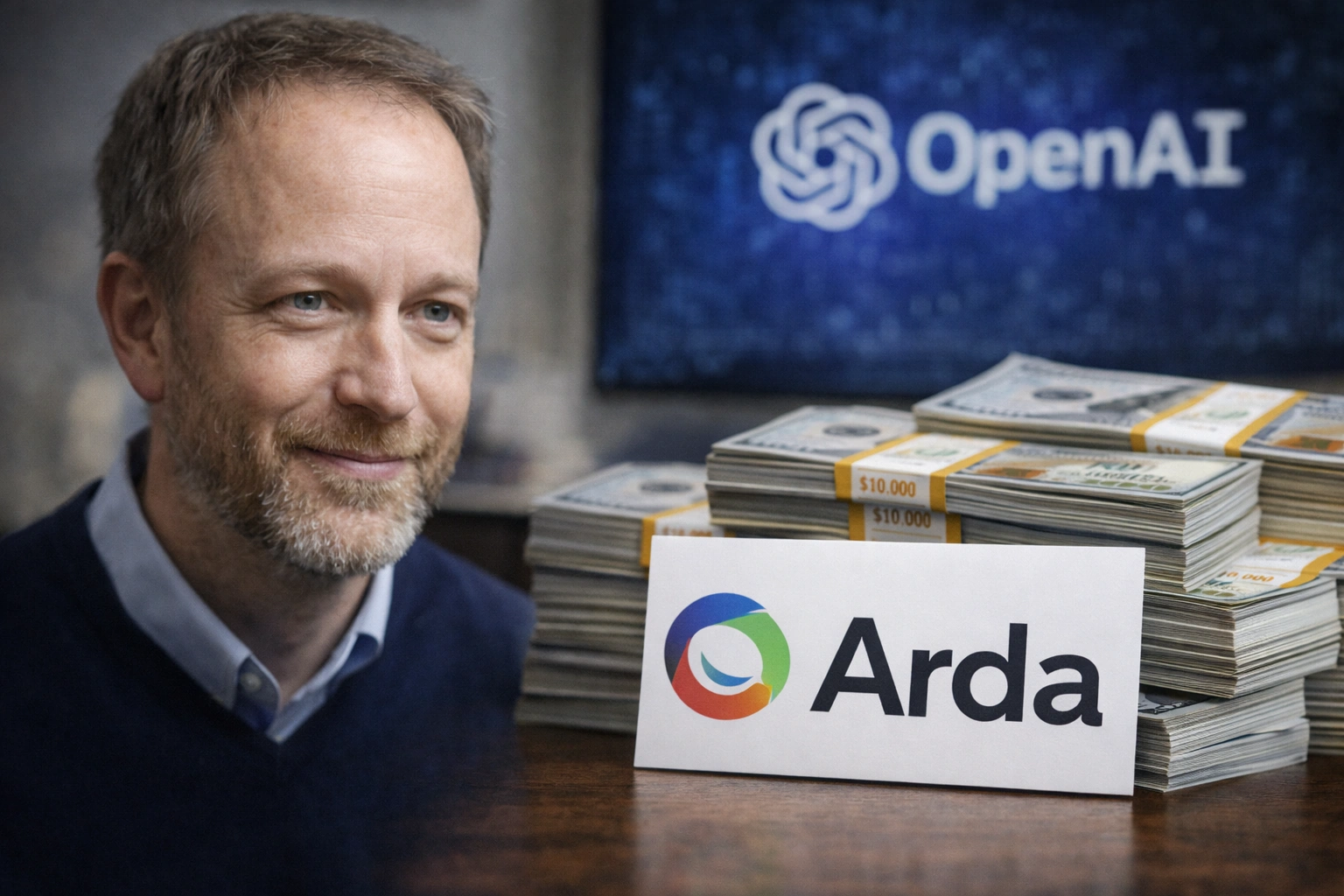
Coin Newsweek – March 5, 2026 – Bob McClure, former chief research officer at OpenAI, is making waves in the AI industry once again, this time with a ambitious new venture aimed at revolutionizing manufacturing. According to sources familiar with the matter, McClure is currently raising $70 million for Arda, an AI and software platform startup designed to bring autonomous intelligence to factory floors.
The new company, co-founded by McClure, is raising funds at a valuation of approximately $700 million. The funding round is being co-led by Founders Fund and Accel, two of Silicon Valley’s most prestigious venture capital firms, with additional participation from Khosla Ventures and XYZ Venture Capital. Sources caution that the round has not yet closed and the terms of the deal are still subject to change.
What Is Arda Building?
Arda is developing a comprehensive AI and software platform that aims to transform how manufacturing operates. At the heart of the technology is a sophisticated video model capable of analyzing footage from factory floors in real-time. This visual data is then used to train robots to operate autonomously within the manufacturing environment, adapting to changing conditions and performing tasks without human intervention.
The company’s software goes beyond simple robotics control. Arda is building an integrated platform that coordinates both machines and people throughout the entire production process. From initial product design and manufacturability assessment to final delivery of finished goods, the system aims to create a seamless, intelligent workflow that optimizes every step.
The Big Picture: Reshoring Manufacturing
The strategic goal behind Arda’s technology is ambitious: making manufacturing in the Western Hemisphere cost-effective again. For decades, production has flowed to regions with lower labor costs, creating complex global supply chains that are vulnerable to disruption. The COVID-19 pandemic and subsequent geopolitical tensions exposed these vulnerabilities, sparking interest in bringing manufacturing closer to end markets.
Arda’s approach tackles the cost challenge not by seeking cheaper labor, but by dramatically increasing productivity through AI and automation. If successful, the platform could enable factories in North America and Europe to compete with low-cost regions on economics, not just quality or speed.
The Team Behind the Vision
Bob McClure brings substantial credibility to the venture. As chief research officer at OpenAI, he was instrumental in developing some of the most advanced AI systems in existence, contributing to breakthroughs in language models and reasoning capabilities. His departure from OpenAI to focus on manufacturing AI signals a belief that industrial applications represent the next frontier for artificial intelligence.
The involvement of top-tier venture capital firms lends further weight to the proposition. Founders Fund, co-founded by Peter Thiel, has a history of backing transformative technology companies. Accel, Khosla Ventures, and XYZ Venture Capital all bring deep expertise in scaling AI and enterprise software businesses.
Why Manufacturing AI Matters
The manufacturing sector has lagged behind other industries in adopting artificial intelligence. While marketing, finance, and customer service have been transformed by AI, factory floors still rely heavily on human labor for tasks that require adaptability and complex decision-making.
Arda’s approach addresses this gap by combining computer vision, robotics control, and production planning into a unified platform. The video model that analyzes factory footage is particularly significant. Unlike traditional industrial automation, which requires carefully structured environments and predefined tasks, Arda’s system can learn from observing human workers, adapting to variations and unexpected situations.
This capability could unlock automation in areas of manufacturing that have resisted traditional robotics, such as assembly tasks requiring fine motor skills or environments where product configurations change frequently.
Market Context and Competition
Arda enters a rapidly evolving market where multiple startups are pursuing different approaches to industrial AI. Some focus on specific verticals like warehouse logistics or quality inspection. Others are building general-purpose robotics platforms. Arda’s emphasis on end-to-end production coordination, from design to delivery, represents a more comprehensive vision.
The $700 million valuation reflects both the size of the opportunity and the strength of the team. Manufacturing is a multi-trillion dollar global industry, and even modest improvements in efficiency translate to enormous value. If Arda can deliver on its vision, the potential market is vast.
What’s Next for Arda
With the funding round not yet closed, Arda remains in its early stages. The company will likely use the capital to expand its engineering team, develop its core technology, and establish partnerships with manufacturing companies for testing and validation.
Industry observers will be watching for signs of customer adoption and technical milestones. The challenge of deploying AI in real-world manufacturing environments is substantial, requiring not just sophisticated algorithms but also integration with existing equipment, workflows, and human workers.
If McClure and his team can navigate these challenges, Arda could play a significant role in reshaping global manufacturing. The combination of OpenAI-caliber AI talent with manufacturing domain expertise creates a compelling formula—one that Silicon Valley’s top investors are betting $70 million on.
Sources: Wall Street Journal / Company announcements
Disclaimer: This content is for market information only and is not investment advice.





