
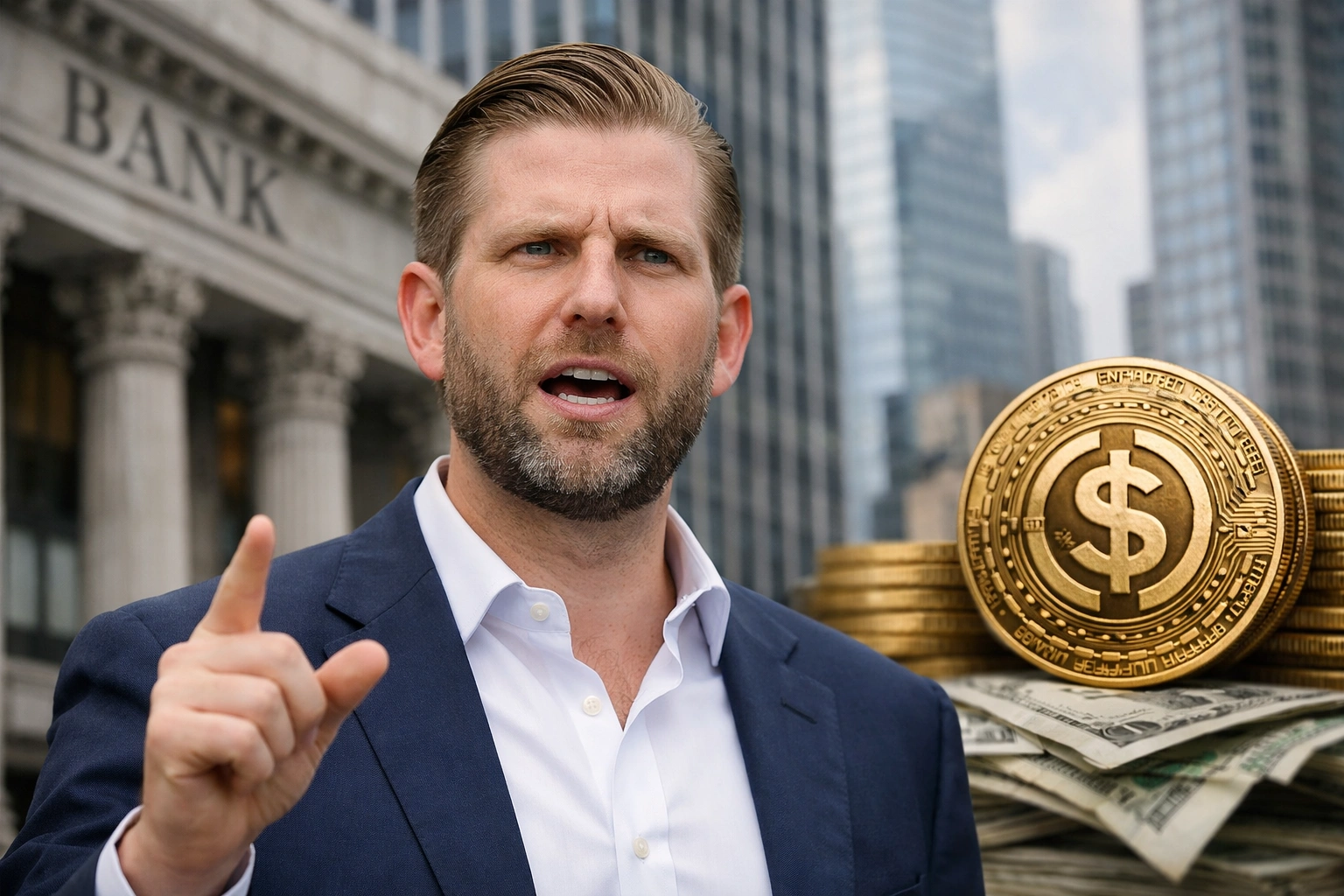
Coin Newsweek – March 5, 2026 – Eric Trump, co-founder of World Liberty Financial (WLFI) and son of President Donald Trump, has launched a blistering attack on major American banks, accusing them of actively working to block Americans from accessing higher yields on their savings through stablecoins. His comments, made on X, frame the banking industry’s lobbying efforts as a self-serving attempt to protect a “low-rate monopoly” at the expense of everyday consumers.
The criticism comes as a crucial legislative battle intensifies in Washington. The CLARITY Act, a bill designed to establish a clear regulatory framework for digital assets, remains stalled in the Senate, with the issue of whether stablecoin holders can earn yield emerging as the primary point of contention between the traditional banking sector and the crypto industry.
Eric Trump: Banks Are ‘Anti-American’ and ‘Anti-Consumer’
In a detailed post on X, Eric Trump laid out his case against the banking giants, pointing to the stark disparity between the interest rates they offer depositors and the rates they receive from the Federal Reserve. He highlighted that major banks like JPMorgan Chase, Bank of America, and Wells Fargo typically offer customers a meager 0.01% to 0.05% APY on standard savings accounts, all while the Fed pays these same institutions over 4% on their reserves. This massive spread, he argued, generates record profits that are never passed down to the average saver.
Big Banks (think JPMorgan Chase, Bank of America, Wells Fargo, etc.) are lobbying overtime to block Americans from getting higher yields on their savings—while trying to block any rewards or perks from being given to customers.
— Eric Trump (@EricTrump) March 5, 2026
Eric Trump then identified the specific target of the banks’ campaign: the crypto and stablecoin industry, where platforms are planning to offer yields of 4–5% or potentially higher. He stated that the American Bankers Association (ABA) and other powerful lobbying groups are “spending millions” to insert provisions into legislation like the CLARITY Act that would limit or completely block these yields.
He dismissed the banks’ public arguments that their opposition is about “fairness” and “stability,” arguing instead that their true motivation is to safeguard their “low-rate monopoly” and prevent customers from moving their deposits to more competitive alternatives. “This is anti-retail, anti-consumer, and straight-up anti-American,” Eric Trump wrote. “Next time you see a big bank dropping billions on a shiny new Midtown Manhattan HQ, you know exactly where that money comes from: the non-existent interest rate they ‘pay’ you!”
President Trump Joins the Fray
Eric Trump’s social media broadside follows similar rhetoric from his father. Earlier this week, President Donald Trump directly accused the banking lobby of “undermining and threatening” the GENIUS Act and holding the CLARITY Act hostage. He urged both sides to find a compromise, emphasizing the importance of a favorable regulatory environment for the crypto industry.
“The Banks should not be trying to undercut The Genius Act, or hold The Clarity Act hostage. They need to make a good deal with the Crypto Industry because that’s what’s in the best interest of the American People,” President Trump posted on social media. This coordinated messaging from the highest political level underscores the growing significance of digital assets as a political issue and highlights the deepening rift between the established financial order and the burgeoning crypto economy.
The Heart of the Dispute: Stablecoin Yields
At the center of the legislative standoff is a seemingly simple question: should holders of stablecoins be allowed to earn interest on their balances? The CLARITY Act, which passed the House with bipartisan support in July 2025, was designed to create a federal framework for digital assets and delineate the regulatory responsibilities of the SEC and CFTC. However, the bill has become bogged down in the Senate Banking Committee over amendments that directly address this issue.
The Senate version of the bill reportedly includes provisions that would restrict companies from paying interest solely for holding stablecoin balances and would limit the scope of reward offerings. These amendments have created a sharp division. Industry players like Coinbase have withdrawn their support for the revised bill, viewing the restrictions as an unfair barrier to innovation. Proponents, largely aligned with the banking sector, argue that offering yield on stablecoins could blur the lines between a payment instrument and a security, potentially creating systemic risks.
The CLARITY Act just changed. The Senate amendment adds more SEC power, more disclosures, tighter stablecoin rules, and DeFi oversight.
A Legislative Deadlock
The White House had set a deadline of March 1 for stakeholders to reach a compromise on the contentious yield issue. This deadline has now passed without any agreement, leaving the CLARITY Act in legislative limbo. Reports indicate that the Senate Banking Committee is considering potential markup sessions for mid-to-late March, but whether a resolution can be found before election-year politics further complicates matters remains highly uncertain.
The failure to meet the deadline injects a new level of uncertainty into the crypto regulatory landscape. The ability to offer yield is a core part of the value proposition for many stablecoins and DeFi platforms. Stifling this feature could fundamentally alter the competitive dynamics of the market. For banks, the prospect of losing low-cost deposits to higher-yielding digital alternatives represents an existential threat to a cornerstone of their business model.
As the Trump family’s rhetoric escalates and the legislative clock ticks, the battle over stablecoin yields has become a defining proxy war for the future of American finance. The outcome will determine not just the fate of one bill, but the balance of power between the traditional financial system and the new wave of digital-first competitors. Eric Trump’s charge of an “anti-American” monopoly may resonate with a public tired of low savings rates, but whether it can break the legislative deadlock remains to be seen.
Sources: Eric Trump X post / Donald Trump X post / Congressional records
Disclaimer: This content is for market information only and is not investment advice.





