
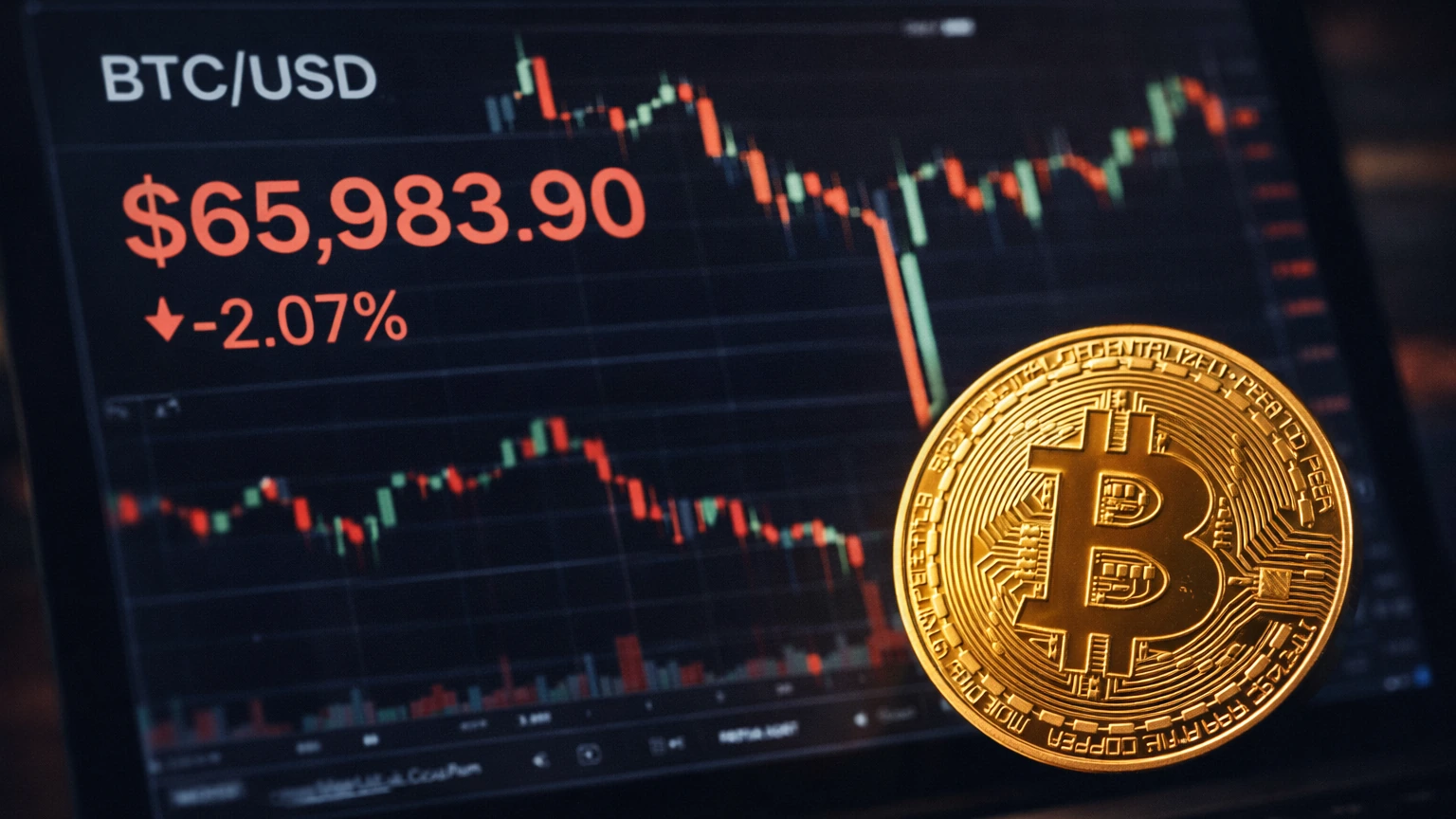
Coin Newsweek – February 27, 2026 (Updated) – Bitcoin has fallen below the $66,000 threshold, extending what is shaping up to be one of the most challenging months for the cryptocurrency in recent memory. According to OKX market data, BTC is currently trading at $65,983.90 per coin, representing a 2.07% decline in today’s session alone.
The drop below $66,000 marks a significant psychological breach, as traders had been watching this level as potential support following weeks of downward pressure. With this latest decline, Bitcoin’s February losses now approach approximately 15%, making it the worst monthly performance since the market turbulence of late 2024.
The sell-off has been broad-based, with the majority of altcoins also trading in negative territory. Ethereum has slipped below $2,000, trading near $1,985, while other major cryptocurrencies including Solana, XRP, and Cardano have posted similar losses ranging from 1.5% to 3% on the day.
Technical Breakdown: Key Levels Breached
From a technical perspective, Bitcoin’s move below $66,000 represents a decisive break of the 200-week exponential moving average, a level that has historically served as a bear-market floor during major drawdowns in 2015, 2018, and 2020. The failure to hold this critical support has opened the door to further downside, with analysts now watching the $62,500 region as the next potential support zone.
The Relative Strength Index (RSI) on daily timeframes has dipped below 40, indicating growing bearish momentum but stopping short of oversold territory. This suggests there may be further room to the downside before sellers exhaust themselves.
Volume analysis reveals that today’s decline has occurred on above-average trading volume, suggesting genuine selling pressure rather than thin-market manipulation. Approximately $2.3 billion in Bitcoin has changed hands in the past 24 hours, significantly exceeding the recent daily average.
ETF Outflows Continue to Pressure Prices
The spot Bitcoin ETF market has added to selling pressure, with data showing continued outflows from these products. After a brief respite earlier in the week, ETF flows turned negative again, with approximately $158 million exiting Bitcoin ETFs in yesterday’s session. BlackRock’s IBIT, typically a magnet for inflows, recorded modest redemptions, while Fidelity’s FBTC saw outflows of approximately $45 million.
Since their peak in January, Bitcoin ETFs have experienced net outflows totaling nearly $2 billion, erasing a significant portion of the inflows that had fueled the rally to all-time highs. This reversal suggests that institutional investors may be reducing exposure or rebalancing portfolios in response to the broader market uncertainty.
Macro Factors Weigh on Sentiment
The cryptocurrency sell-off is occurring against a backdrop of broader macro uncertainty. Fresh concerns about global trade tensions have emerged following statements from US Trade Representative Jamieson Greer indicating that President Trump intends to raise global tariffs to 15% “where appropriate.” Trade-sensitive markets have reacted negatively, with equity futures also pointing lower.
Additionally, the Federal Reserve’s stance on interest rates continues to influence risk asset pricing. While markets had priced in three rate cuts for 2026, recent hawkish commentary from Fed officials has introduced doubt about the timing and magnitude of monetary easing. Higher-for-longer interest rates typically pressure non-yielding assets like Bitcoin.
Derivatives Market Shows Capitulation Signs
Bitcoin’s derivatives market is flashing mixed signals. Open interest in futures has declined by approximately 12% over the past week, suggesting that leveraged traders are being flushed out of positions. Funding rates across major exchanges have turned negative, indicating that short sellers are now paying to maintain their positions—a condition that can sometimes precede short squeezes.
However, the options market tells a more cautious story. The 30-day put-call skew has widened to 14%, meaning downside protection remains expensive relative to upside speculation. Professional traders continue hedging against further declines rather than positioning for a rebound.
Long-Term Holders: The Supply Dynamic
On-chain data reveals that long-term holders have continued to distribute supply during this decline. The Long-Term Holder Net Position Change metric shows a reduction of approximately 65,000 BTC over the past 30 days, indicating that even staunch Bitcoin believers are reducing exposure at current levels.
This distribution by strong hands contrasts with typical bear market bottoms, where long-term holders are accumulating rather than selling. Until this dynamic reverses, sustainable upside may remain limited.
Analyst Perspectives: Bottom Hunting Begins
Despite the bleak price action, some analysts are beginning to suggest that the worst may be priced in. CryptoQuant data indicates that short-term holder SOPR (Spent Output Profit Ratio) has dropped below 1, suggesting that recent sellers are realizing losses—a condition that often precedes market bottoms.
However, more cautious voices point to macro uncertainty and the lack of fresh catalysts as reasons to remain defensive. The $60,000 level looms as a psychological barrier that, if breached, could trigger another wave of selling from traders with stop losses clustered in that region.
Looking Ahead: What’s Next for Bitcoin?
With Bitcoin now trading below $66,000, market participants are watching several key levels and catalysts. The immediate focus will be on whether BTC can reclaim the $66,000-$66,500 zone as support or whether selling pressure intensifies toward $62,500.
Upcoming catalysts include Friday’s PCE inflation data, which could influence Fed policy expectations, and any developments in the ongoing tariff discussions. Additionally, the March options expiry, with approximately $5.8 billion in notional value set to expire, could introduce volatility later next week.
For now, Bitcoin finds itself at a critical juncture. The breakdown below key technical levels, combined with persistent ETF outflows and macro uncertainty, suggests that the path of least resistance may remain lower. However, the washout in leveraged positions and capitulation signals from on-chain data suggest that a sustainable bottom may eventually emerge—even if it hasn’t arrived yet.
Sources: OKX market data / TradingView / Glassnode / SoSoValue / CME Group
Disclaimer: This content is for market information only and is not investment advice.





