
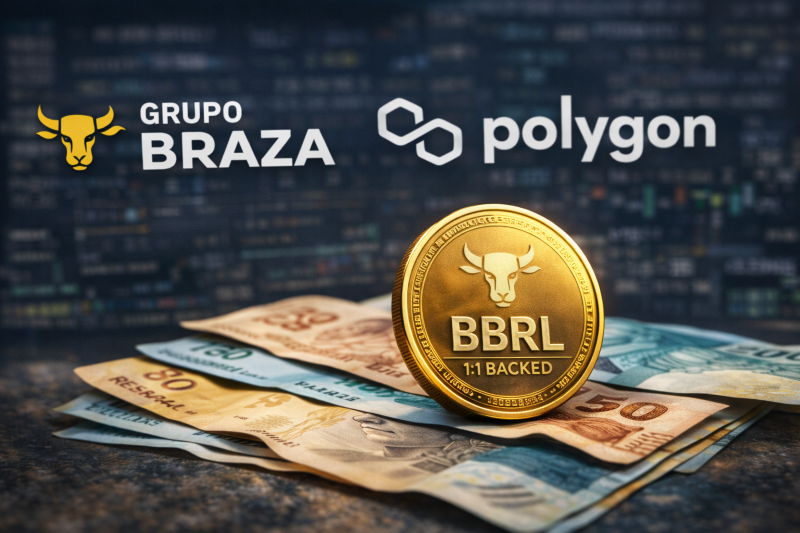
Coin Newsweek – February 25, 2026 – In a significant development for Latin American cryptocurrency adoption, Grupo Braza’s foreign exchange bank Banco Braza has announced the expansion of its Brazilian real-pegged stablecoin BBRL to the Polygon network. The move brings a fully regulated, fiat-backed digital asset to one of the blockchain industry’s most active layer-2 ecosystems.
BBRL stands apart from many stablecoins in the market due to its institutional pedigree. Issued by an entity under the direct supervision of the Central Bank of Brazil, the token maintains a strict 1:1 reserve backing with Brazilian reais held by the bank. Regular third-party audits provide transparency and verify the adequacy of reserves, addressing concerns that have plagued less regulated stablecoin issuers.
The expansion to Polygon opens new frontiers for Brazilian users and businesses seeking to participate in decentralized finance without exposing themselves to the volatility of cryptocurrencies or the regulatory uncertainty of offshore stablecoins. On Polygon, BBRL can be used for lending, borrowing, trading, and payments within an ecosystem known for its low fees and high transaction throughput.
Polygon has established itself as a preferred scaling solution for Ethereum, offering compatibility with the broader Ethereum ecosystem while delivering faster and cheaper transactions. This technical foundation makes it an ideal home for a stablecoin designed for real-world use cases where transaction costs matter.
For the Brazilian market, the availability of a regulated real-denominated stablecoin on a major blockchain network represents a watershed moment. Users can now move value on-chain in their local currency without the friction of converting to dollar-pegged stablecoins and back, reducing costs and complexity for cross-border payments, remittances, and crypto commerce.
Banco Braza’s foreign exchange expertise provides the operational backbone for BBRL’s reserve management and redemption mechanisms. With deep experience in currency markets, the institution understands the importance of maintaining perfect 1:1 convertibility and transparent reporting to sustain user trust.
The regular audit requirement adds a critical layer of accountability. By subjecting its reserves to periodic verification by independent third parties, Banco Braza signals its commitment to operating with the transparency that institutional users and regulators expect from financial institutions.
Polygon’s growing footprint in Latin America makes it a natural choice for BBRL’s expansion. The region has emerged as a hotbed for cryptocurrency adoption, with users seeking alternatives to volatile local currencies and limited traditional banking access. Polygon’s low fee structure aligns well with the frequent, smaller transactions that characterize real-world stablecoin usage.
For developers building on Polygon, BBRL expands the toolkit of stable assets available for DeFi protocols, payment applications, and other blockchain-based services. Brazilian real-denominated lending markets, synthetic assets, and payment rails can now be built without reliance on off-chain banking infrastructure or unregulated stablecoins.
The institutional backing of BBRL provides a level of regulatory certainty that distinguishes it from competitors. As Brazil’s central bank continues to develop its digital currency framework, regulated private-sector initiatives like BBRL demonstrate how traditional financial institutions can bridge the gap between conventional banking and blockchain technology.
BBRL’s arrival on Polygon also speaks to the broader trend of traditional finance embracing blockchain infrastructure. Rather than viewing cryptocurrencies as threats, forward-thinking banks are recognizing the opportunity to participate in the digital asset ecosystem by offering regulated, fiat-backed tokens that combine the best of both worlds.
The Brazilian real has demonstrated relative stability compared to other emerging market currencies, enhancing its suitability as a stablecoin base. Users seeking to preserve value in reais while accessing the benefits of decentralized finance now have a regulated on-ramp through BBRL on Polygon.
Polygon’s interoperability with Ethereum through bridges and cross-chain protocols means BBRL’s reach extends beyond the immediate Polygon ecosystem. This connectivity positions BBRL to serve users across multiple blockchain networks as the multi-chain future continues to unfold.
For Grupo Braza, the expansion represents a strategic bet on the convergence of traditional finance and decentralized technology. By establishing BBRL on Polygon, the banking group positions itself at the forefront of regulated stablecoin issuance in Latin America’s largest economy.
As the stablecoin landscape matures, initiatives like BBRL on Polygon demonstrate a viable path forward: regulated financial institutions issuing transparent, audited digital assets on scalable, accessible blockchain infrastructure. This combination of institutional trust and technological innovation may well define the next phase of digital money evolution.
Source: Grupo Braza / Banco Braza official announcement
Disclaimer: This content is for market information only and is not investment advice.





