
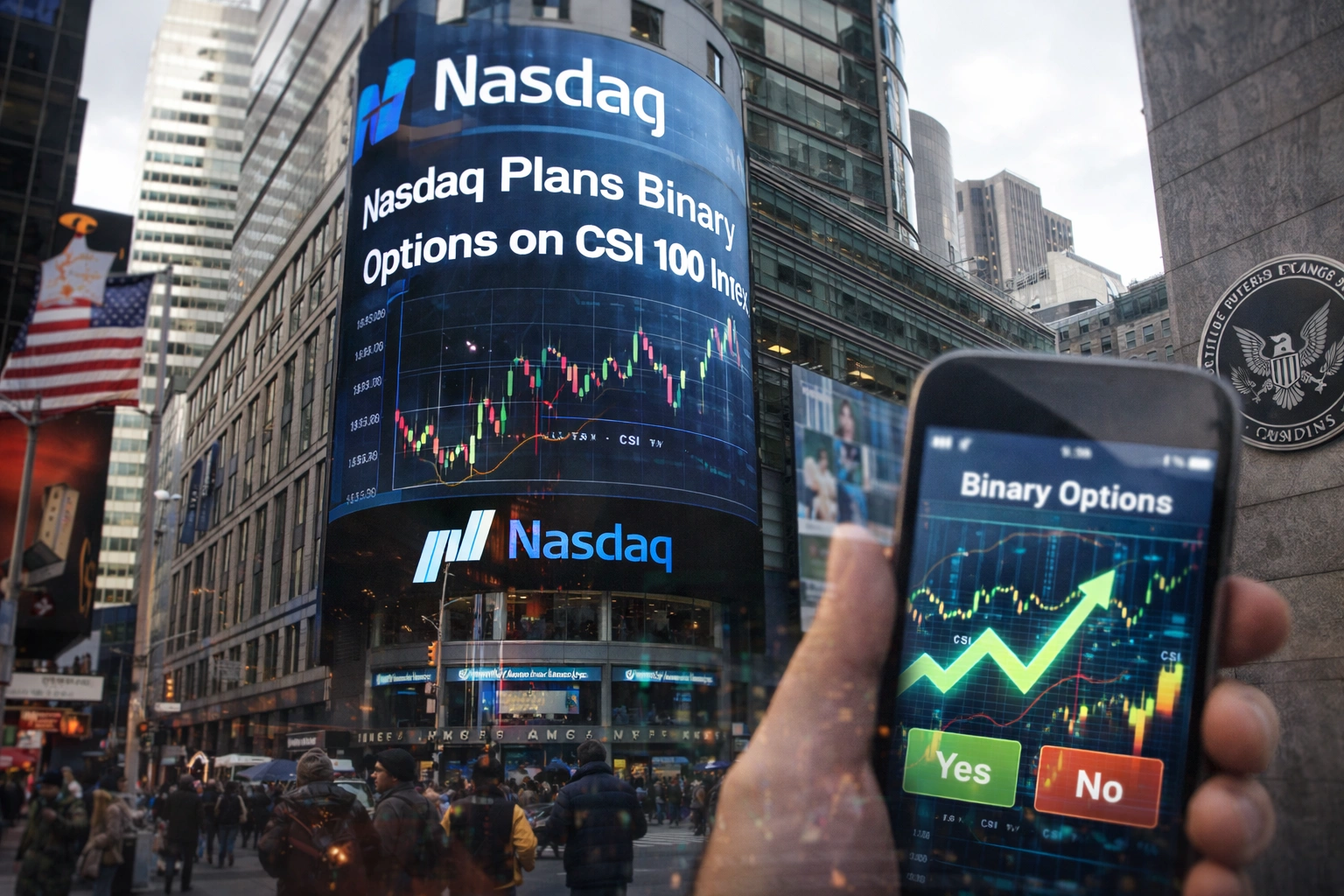
Coin Newsweek – March 2, 2026 – Nasdaq Inc. is making a strategic leap into the rapidly expanding prediction market sector, filing plans with U.S. regulators to list binary options contracts tied to its flagship Nasdaq 100 Index. The move positions the global exchange operator at the intersection of traditional finance and the burgeoning world of event-based trading, bringing a regulated, simplified derivative to one of the world’s most actively followed benchmarks.
According to a proposed rule change submitted to the U.S. Securities and Exchange Commission (SEC), Nasdaq intends to list “binary options” on both the standard Nasdaq 100 Index and the Nasdaq 100 Micro Index. Unlike conventional options with sliding scales of payouts, these contracts are designed as straightforward “yes or no” propositions. They would trade at a price between $0.01 and $1.00, with the price reflecting the market’s collective assessment of the probability that a specific event—such as the index closing above a predetermined level—will occur. If the event happens, the contract settles at $1; if not, it expires worthless.
This initiative marks Nasdaq’s first foray into products that directly mirror the mechanics of prediction markets. These so-called “Outcome Related Options” would allow traders to take binary positions on whether a specified event happens, offering a simplified alternative to the complex Greeks and time decay associated with traditional options.
The Rise of Prediction Markets: A New Financial Frontier
Nasdaq’s move comes at a time when prediction markets have exploded into the financial mainstream. Platforms like Kalshi and Polymarket have seen trading volumes surge into the billions, with traders betting on everything from Federal Reserve interest rate decisions to sports outcomes and political elections. Robinhood, the retail trading giant, has aggressively entered the space, recently acquiring a majority stake in the CFTC-regulated exchange MIAXdx to power its own event contracts, which have already surpassed 11 billion in cumulative trades.
In January 2026 alone, Kalshi and Polymarket combined for a record $17 billion in trading volume, signaling an insatiable appetite for this new asset class. The sector has attracted institutional attention as well, with the Intercontinental Exchange (ICE), parent company of the New York Stock Exchange, making a landmark $2 billion investment in Polymarket in late 2025.
Nasdaq’s Product: A Regulated Twist on a Simple Bet
Nasdaq’s proposed binary options differ from the event contracts offered by Kalshi or Polymarket in a crucial way: regulatory jurisdiction. While platforms like Kalshi are overseen by the Commodity Futures Trading Commission (CFTC), Nasdaq’s binary options would fall under the purview of the SEC.
The contracts will be based on the performance of the Nasdaq 100, which tracks the 100 largest non-financial companies listed on the exchange, including tech giants like Nvidia and Apple. The index is already a favorite among day traders, with a massive volume of options changing hands daily. These new binary options would provide an even more direct and simplified method for traders to express a view on the index’s direction.
This is not the first time such products have been proposed. Cboe Global Markets is also in early-stage discussions to relaunch “all-or-nothing” binary options, aiming to capture a slice of the prediction market boom. Cboe previously listed similar contracts in 2008 but discontinued them due to lack of traction. Now, with a more mature retail audience and a clearer regulatory path, the revival of binary options appears to be gaining serious momentum.
Regulatory Landscape and the Path Forward
The success of Nasdaq’s venture hinges on SEC approval. The filing is currently pending, and the regulatory timeline remains uncertain. However, the broader regulatory environment for event-based trading has become more favorable following the passage of the CLARITY Act in 2025, which provided a clearer legal framework for these products. This legislation has helped pave the way for mainstream adoption, though a “messy standoff” remains at the state level, with some regulators arguing that sports-based contracts constitute unlicensed gambling.
For Nasdaq, the focus is purely on financial outcomes. By limiting the contracts to its own well-established index, the exchange is positioning the product firmly within the securities space, which may help navigate the complex jurisdictional waters between federal and state authorities.
Implications for Traders and the Broader Market
If approved, Nasdaq’s binary options would offer several advantages. Their simplicity makes them accessible to a broader range of traders who may find traditional options intimidating. The fixed payout structure eliminates the complexity of strike prices and expiration dates, allowing users to focus purely on their directional conviction. Additionally, as a product listed on a major exchange, they offer the transparency and security of a regulated marketplace.
The entry of Nasdaq into this space also validates the prediction market model as a legitimate and enduring part of the financial ecosystem. For years, these markets operated in a regulatory gray area, often associated with offshore platforms. Now, with major players like Nasdaq, Cboe, and Robinhood entering the fray, event-driven trading is cementing its place alongside stocks, bonds, and derivatives as a core component of modern finance.
The coming months will be critical. As the SEC reviews Nasdaq’s proposal, the industry will be watching closely for signals on how regulators intend to treat these hybrid products. If approved, Nasdaq’s binary options could open the floodgates for a new wave of exchange-listed prediction products, further blurring the lines between investing, trading, and forecasting.
Sources: Bloomberg / The Block / Wedbush Securities / Odaily
Disclaimer: This content is for market information only and is not investment advice.





